Comments Guidelines

All comments are pre-moderated. No spam, slurs, personal attacks, or foul language will be allowed.

Thursday, February 23, 2012

Iceland Solves Banking Crisis by Indicting CEOs, Forcing Mortgage Relief

Via Mark Thoma's Economist View, I came across an interesting blog on financial regulation called Trust Your Instincts. Lately, the author, "Richard," has written a set of posts comparing two models of dealing with the financial crisis, which he calls the Swedish model (used by Sweden and Iceland) and the Japanese model (used by Japan, the U.S., and the U.K.).

Here is his description of the two models:
Regular readers know that under the Japanese model losses on the excesses in the financial system are only recognized as banks generate the capital to absorb them.  This is good for banks because the model involves hiding their true condition and pursuing policies designed to boost bank earnings.  It is bad for the economy because it distorts asset prices and access to capital (for proof, look at the performance of Japan's economy).

The alternative is a Swedish model that is bad for banks and good for the economy.  It is bad for banks because they are required to recognize the losses on the excesses in the financial system today.  It is good for the economy because it avoids the distortion in asset prices and access to funding associated with hiding the losses under the Japanese model (for proof, look at the performance of Sweden's economy).
 Richard points to recent events in Iceland as another successful application of Sweden's model. There, the country's banks forgave loans equivalent to 13% of gross domestic product, according to a Bloomberg article Richard cites. The equivalent in the United States would be about $1.95 trillion of mortgage debt writedowns. Icelandic banks agreed to forgive all mortgage debt over 110% of a home's value.

Not only that, Bloomberg relates a development that would meet, I believe, with the approval of Tea Party members and Occupy protesters alike: Bankers were held personally liable for crashing the country's economy. The CEO's of the country's three largest banks are among 200 who are facing criminal charges, and a special prosecutor expects up to 90 more indictments. The contrast with the United States could not be more obvious.

While Iceland is a tiny country with a population of only 317,000 and a $13 billion GDP, Trust Your Instincts is not the only blog paying attention to it. As Paul Krugman wrote yesterday, "I think I may have been one of the first commentators with a wide audience to point out how relatively well Iceland was doing." What he didn't mention, though his commentator "iInfoliner" did, is that the credit rating agency Fitch upgraded Iceland's debt to investment grade last week. Moreover, according to the Business Week story, the country can now borrow in U.S. dollars at a mere 4.77%. Compare this to Greece at 35.98% and Portugal at 12.77%; even Spain and Italy are a little over 5% (the FT link has no rates listed for Ireland).

The moral of the story is that a different approach to dealing with the banks is necessary, both to restore the U.S. economy but to prosecute financiers who broke the law. As it stands, bankers have gotten off scot-free while the country's economic growth has been largely anemic. While the job market has shown a few flickers of life recently, the country needs millions of jobs just to get back where it was before the crash, which actually wasn't all that good a situation for the middle class to begin with.

It could be worse, I suppose. As Richard says, Japan's economy remains smaller than 15 years ago. But Ben Bernanke was rumored to have learned the lessons of the Japanese experience. Whatever happened to that guy?

Wednesday, February 22, 2012

Romney Tax Plan Blows Hole in Budget, Remains Short on Specifics

Mitt Romney unveiled his tax plan today, but it revealed few surprises except for surprisingly few specifics. Via Chris Hayes (@chrislhayes), conservative economist Josh Barro estimates that the Romney plan consists of $5 trillion in tax cuts over 10 years, divided as follows:

$1 trillion from cutting the corporate income tax
$3 trillion from cutting all personal income tax rates by 20% (not 20 percentage points, by the way)
$1 trillion from miscellaneous tax cuts like abolishing the alternative minimum tax (AMT)

According to the Romney plan, the corporate income tax rate would fall from 35% to 25% and the U.S. would stop taxing countries on their foreign profits. Contrary to Romney's claim, making foreign profits tax-free would not encourage their investment in the U.S., but would instead give companies an incentive to make more of their profits appear to be foreign by creative use of transfer pricing to make profits show up in tax havens instead of the U.S. Under the Romney plan, companies would then be free to bring that money back to the U.S. without facing any tax, anywhere in the world.

Among the other non-surprises in the plan, Romney would not increase the 15% tax rate on his own main source of income, capital gains. He would repeal the Affordable Care Act, even though his version of it in Massachusetts gave the state the highest level of insurance coverage in the country at 95%. He would raise the eligibility age for Social Security and end Medicare as we know it a la the Ryan Plan, two staples of conservative talking points that would negatively affect the middle class.

As Barro points out, Romney has said before that he will increase American military spending (already tops in the world by far). This makes it even more difficult for him to offset the $5 billion in tax cuts without huge cuts to programs that the middle class depends on. Thus, I think the inescapable conclusion is that of Benjy Sarlin: "Romney's Tax Plan Still a Boon to the Rich, Despite 1% Talk."

Tuesday, February 21, 2012

Bad Trends in Economic Development: Weak Negotiating, Job Piracy and Blackmail

Greg LeRoy at Good Jobs First's "Clawback" blog reports that Sears has now announced 100 layoffs in its headquarters in Illinois, despite receiving a subsidy of $275 million (nominal value) to stay in the state when it threatened to move last year. It's bad enough that Sears threatened relocation in order to extract subsidies from the state, as Julie Irwin Zimmerman ably discussed in December. What's more troubling, as LeRoy points out, is that under the agreement Sears can lay off a total of 1750 headquarters workers (which would take the firm from its initial 6000 jobs to 4250) without penalty. This is a stunning capitulation that represents backsliding from a trend to require more of subsidized companies (see the December 2011 Good Jobs First report Money for Something).

But it's not the only example of this sort of backsliding. As I reported in September, the state of Tennessee did not include clawback clauses in huge subsidy agreements with Electrolux, Hemlock Semiconductor, and Wacker Chemie. The jobs crisis apparently has made some states afraid to assert themselves in investment incentive negotiations.

Sears is only one high-profile example of actual or threatened relocations that resulted in subsidies. As Good Jobs First reports on Minnesota (2006) and Ohio (2011)  have documented, 250 companies and over 24,000 jobs were relocated on the taxpayer's dime over various study periods in the Minneapolis/St. Paul, Cleveland, and Cincinnati metro areas alone, with sprawl-enhancing effects in all three cases.

To see how widespread subsidized relocation is, I performed a simple search in the Nexis news database (subscription required). It was:

relocat! AND "tax incentives" OR "tax breaks"

With the wildcard "!" symbol, Nexis searches for all variants of the word "relocation." When I set the time period for articles in the last year, I got 1,000 results, the maximum it will return. Searching for the last six months: 1,000 results. Searching for the last three months: 998 results. Only when I narrowed the search to the last month did I get a mere 519 results.

Of course, not all the stories are from the U.S., many are not about job piracy, and there are often duplicate articles. But these huge numbers over such a short period of time suggest that there is a great deal we have yet to discover about relocation incentives, and they may be far more prevalent than I would ever have imagined.

Sunday, February 19, 2012

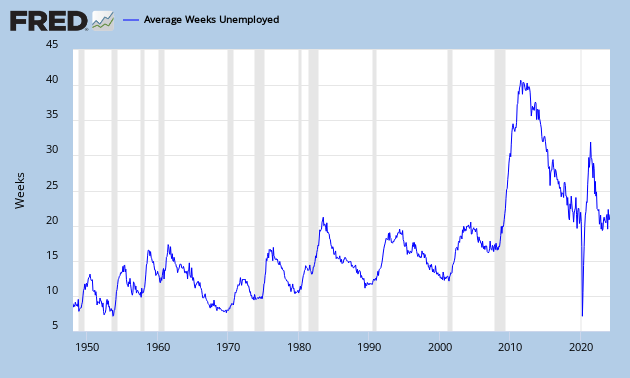
Basics: Length of Unemployment is Worst Since World War II.

Update: As has been pointed out to me several times, "historically unprecedented" is not correct. I assume that duration of unemployment was longer during the Great Depression. The FRED data below obviously only goes back to 1947. So while "completely unprecedented historically" is literally not correct, duration of unemployment is still off the charts for the postwar era, at just under twice the previous peak.

One thing I've learned since I started blogging is how much people want to see information that puts our current economic situation in perspective. One way to do that, a natural one to me since my specialty is international relations, is to use multi-country comparisons to see where the U.S. stands. Usually this means comparisons with other industrialized countries, although my post on employment protection had data for Brazil, Russia, India, and China as well because the Organization for Economic Cooperation and Development provided it. Moreover, it was striking that the United States would have even worse standards than some developing countries.

Besides that kind of "cross-sectional" comparison of multiple countries at a single point in time, another way to gain perspective is through "longitudinal" comparison of data on one issue through time. Today's post takes that approach. I decided to learn how to use the St. Louis Federal Reserve Bank data you often see in other blogs--although it turns out "learn" is too strong a word because the "FRED" website (https://research.stlouisfed.org/fred2/) is so simple to use. That set me up for a shock to find out how bad long-term unemployment (usually defined as 26 weeks or more) is today. This is a critical issue because the longer you are out of work, the less likely you are to ever find a job again. Unemployment is also critical for health care, as most Americans still get their health insurance through their employers.

As everyone knows, long-term unemployment has been a big problem in the current crisis. But "knowing" isn't the same as having perspective. For that, we need a comparison. It turns out that the average duration of unemployment over the last few months is almost exactly twice as high as the previous peak in 1983 in the aftermath of the Reagan recession. The current average of over 40 weeks is completely unprecedented historically (as is the median length of unemployment, which was also twice that of prior peaks at about 22 weeks when Politifact reported on it in May 2011). But you have to see it to really understand it: Unemployment duration has increased steadily even since the end of the official recession, and may finally have topped out at 40.9 weeks in November 2011. Let's hope we're finally seeing a reduction.

FRED Graph

Tuesday, February 14, 2012

Drug Shortages Highlight Failures of For-Profit Health Care

Rick Ungar (via @Captain Clarion and @AggressiveProgresive) has a great catch and analysis at Forbes, "Proof of the Failure of Free Markets in Medicine." He discusses the shortage of the cancer drug methotrexate, which has an 80-90% success rate in treating the most common (and once always fatal) form of leukemia, acute lymphoblastic leukemia (ALL). The medication, now off patent, is apparently no longer profitable enough for the five U.S. makers of this drug, and methotrexate is one of a number of life-saving medicines in short supply. There are approximately 3000 new cases of ALL each year diagnosed in young children.

As Ungar argues, it is implausible that all five current manufacturers of methotrexate are simultaneously having production delays:
What are the odds that 100 percent of these companies are, somehow, each experiencing manufacturing delays?  Does anyone imagine that these manufacturing delays were occurring back when these companies were making big bucks on the product, achieved by the huge mark-ups that accompany receipt of the patent protection that bars others from competing?
The Huffington Post's Linda A. Johnson reports that the five companies are Ben Venue Laboratories Inc., APP Pharmaceuticals LLC, Hospira Inc., Sandoz Inc., and Mylan Inc. She also notes that Ben Venue was the sole U.S. producer of the breast cancer drug doxil, which with methotrexate was affected by a November shutdown of a company plant in Ohio after regulators found recurrent drug safety problems.

When production of these drugs falters, people die. As Ungar puts it, "This means that kids are dying —and will continue dying— because the money just isn’t what it used to be for the five manufacturers who have long supplied the critical medicine."

If we think that's wrong, it's necessary to address the problems of the patent system, which leads to high profits (and medicines unaffordable in developing countries, according to Susan Sell) during the patent's life but abandonment of vital medications after the end of the patent. Instead, we are at present having to fight off attempts to expand protection of patents and other intellectual property: the for-now neutralized SOPA and PIPA, as well as the Anti Counterfeiting Trade Agreement and the Trans-Pacific Partnership. Ungar suggests that the patent system be modified to take into account whether companies stopped making needed drugs after previous patents expired. This could be helpful, but the deeper question is whether patent protections are too strong already and need to reduced.

Basics: U.S. Students Score About Average in OECD Testing Program

Every three years, the Organization for Economic Cooperation and Development carries out its Program for International Student Assessment, PISA. The 2009 edition covered 65 countries and focused on reading, but included test results for math and science as well. PISA tests students who are 15 years, 3 months old to 16 years, two months old to
assess the extent to which students near the end of compulsory education have acquired some of the knowledge and skills that are essential for full participation in modern societies (PISA Results, Volume I, p. 19)
 In addition to the 34 OECD member nations, a further 31 "partner countries" take part. Some of these partners, such as Shanghai, were among the top performers, despite lower education budgets than in the OECD and wide socioeconomic disparities within them. In fact, Shanghai topped the list in all three categories (see below).

The U.S. scores on the high end of average in reading and science, and just below average in math. As the table below shows, America scores better than a few countries often thought of as more "socially advanced," such as Sweden. Though there is obviously room for improvement (and the PISA report discusses improved scores in countries as diverse as South Korea, Poland, Germany, and Brazil), the sky is not falling on U.S. education just yet.

In future posts, I plan to take up more education-related issues. Here, I wanted to show that the U.S. is not starting from as bad a baseline as it does, for example, in health care. Without further ado, here are the PISA scores for the top 50 countries:


Country
Reading Math Science


Shanghai-China
556 600 575
Korea
539 546 538
Finland
536 541 554
Hong Kong-China
533 555 549
Singapore
526 562 542
Canada
524 527 529
New Zealand
521 519 532
Japan
520 529 539
Australia
515 514 527
Netherlands
508 526 522
Belgium
506 515 507
Norway
503 498 500
Estonia
501 512 528
Switzerland
501 534 517
Poland
500 495 508
Iceland
500 507 496
United States
500 487 502
Liechtenstein
499 536 520
Sweden
497 494 495
Germany
497 513 520
Ireland
496 487 508
France
496 497 498
Chinese Taipei
495 543 520
Denmark
495 503 499
United Kingdom
494 492 514
Hungary
494 490 503
Portugal
489 487 493
Macao-China
487 525 511
Italy
486 483 489
Latvia
484 482 494
Slovenia
483 501 512
Greece
483 466 470
Spain
481 483 488
Czech Republic
478 493 500
Slovak Republic
477 497 490
Croatia
476 460 486
Israel
474 447 455
Luxembourg
472 489 484
Austria
470 496 494
Lithuania
468 477 491
Turkey
464 445 454
Dubai (UAE)
459 453 466
Russian Federation
459 468 478
Chile
449 421 447
Serbia
442 442 443
Bulgaria
429 428 439
Uruguay
426 427 427
Mexico
425 419 416
Romania
424 427 428
Thailand
421 419 425


Source: OECD, PISA 2009 Database


http://dx.doi.org/10.1787/888932343342


Thursday, February 9, 2012

Conservatives Refute Butler/Heritage Revisionism

@gregvarner points me to a new article at Forbes where Avik Roy tries in vain to find a reference to the individual mandate before the Heritage Foundation, specifically Stuart Butler, started publishing research on it in 1989. Citing the same 1989 lecture I did (and Krugman before me) in my last post, Roy concludes:
Based on my research, I see no contravening evidence to the claim that Stuart Butler and Heritage were the first people to advocate the individual mandate, in the context of a private-sector health-care system.
Roy is at pains to say that Heritage and Butler are now right to oppose the individual mandate, but nowhere does he give any evidence that they changed their minds on it prior to President Obama's election. Unless he (or Butler) give such evidence, it will be hard to take seriously the claim that the "change of heart" isn't merely political opportunism.

As I mentioned in my last post, you can't give a lecture on something without previously researching it, and Roy gives an update linking to James Taranto at the Wall Street Journal, who also isn't buying "Butler's claim of unoriginality," and who finds the research piece that preceded the lecture. "A National Health System for America," edited by Butler and Edmund Haislmaier, is a major 140-page research document. Although it is dated on the Heritage website as January 2, 1989, as Taranto says the Washington Post news story about the book states it was released June 1 of that year (which I verified using the Nexis subscription service). What Taranto does not notice is that this document is clearly labeled on its cover "Revised Edition." This could well push the original version and the original research back into 1988 or earlier.

Not only that, Taranto finds multiple elements of the Affordable Care Act in the research monograph, including its enforcement mechanism.

To Heritage's credit, it has not scrubbed its website of either the lecture or the research document, but the fact remains that these documents appear to be the ultimate source of the individual mandate. Butler has yet to cite another source or acknowledge that he was working on it in the 1980s, not just the 1990s. As Taranto concludes in Butler's case, "Acknowledging error is a sign of integrity, but you have to be truthful about it." Amen to that.