Comments Guidelines

All comments are pre-moderated. No spam, slurs, personal attacks, or foul language will be allowed.
Showing posts with label Mitt Romney. Show all posts

Monday, August 4, 2014

Illinois' next governor may make Romney look like a saint UPDATED

Does the name Bruce Rauner ring a bell? No, me neither. It turns out he's the Republican nominee for governor in Illinois, which under normal circumstances would mean he's a nobody. But he's been leading incumbent Democrat Pat Quinn in polls all summer, and could actually end up as the state's next governor.

This is a problem, because he is even more out of touch with the middle class than Mitt Romney (Rauner is a private equity near-billionaire) whose idea of transparency is to release the first two pages of his 1040 tax return for 2010-12, and nothing else. Romney at least released his full tax return for each of two years. As Think Progress points out, Rauner is also a big fan of the Cayman Islands as a tax haven, just like Romney. In fact, Rauner is invested in at least five funds there. Also like Romney, Rauner takes full advantage of the "carried interest" tax break that lets him treat his fees, which should be ordinary income taxed at 35 39.6%, as capital gains, subject only to a 15 20% tax rate.

Rauner's agenda is insistent on the need to spur job growth, but somehow misses the fact that Illinois' unemployment rate has fallen from 9.2% (seasonally adjusted) in June 2013 to 7.5% in May 2013 (the figure Rauner used) and even more since the agenda was published, to 7.1% in June, the third-largest drop in the country year-over-year. Still a full point worse than the June national unemployment rate, but a lot better than it was.

One place where Rauner is worse than Romney is the minimum wage. Romney, rather surprisingly, supports an increase in the minimum wage, though he did not specify a number. Rauner, in both December and January, called for Illinois to lower its minimum from $8.25 to $7.25, the national rate. After getting a tremendous amount of blowback, he now claims to support an increase.

His agenda says the state "should implement a phased-in minimum wage increase, coupled with workers' compensation and lawsuit reforms to bring down employer costs." No mention of what the rate would be, or the period over which it would be phased it. He references an op-ed he wrote in the January 9th Chicago Tribune (now only available through the Nexis subscription service), where he clearly buys into the "job-killer" meme and drops a reference to the futility of a "$20 per hour" minimum wage, for good measure. Somehow I don't think he really supports an increase.

Not only that, but Rauner proposes turning the Illinois Department of Commerce and Economic Opportunity, the state's investment promotion agency, into what he calls a "public-private partnership." He doesn't say it, but this means there will be less public oversight into the agency's affairs. As Good Jobs First has shown, such privatized agencies have exhibited high levels of abuse in recent years.

Rauner is a living, breathing example of how we have one tax system for the 1%, and another one for the rest of us. His flip-flop on the minimum wage is as phony as the concern he professes for the middle class. Yet there's a very good chance he will be the next governor of Illinois.

UPDATE: Crooks and Liars links to a brief video where Rauner says it may be necessary to go through a period in Illinois like that when President Ronald Reagan fired the air traffic controllers.

Argyrios at Daily Kos reminds me that the tax brackets have increased. Thanks.

Cross-posted at Angry Bear.

Monday, November 5, 2012

Bain Capital Avoided $102 Million in Taxes Via Dutch Subsidiary UPDATED

A Dutch newspaper, de Volkskrant, reports today (translation here) that Bain Capital used a Dutch subsidiary to avoid $102 million on its taxes. This has been picked up by Taegan Goddard  and the Atlantic Wire. The Dutch author wrote a comment on Goddard’s site clarifying that Bain (not Romney) saved $102 million. From his 2010 and 2011 tax returns, Romney received $2.1 million in dividends and $5.5 million in capital gains. Of course, who knows what he received in previous years, since Romney hasn’t released more tax returns?

Since all the original analysis is in Dutch, which I can't speak, it's hard to say much further at this point, though Bain and the Romney campaign predictably refused to comment. However, the report does show the statement for Bain Capital Fund VIII for the first nine months of 2010 (part of the documents leaked to Gawker, I believe). One illuminating nugget on how private equity makes its money is that the fund reported $174,493,175 in income for the nine months, and a staggering management fee of $46,746,696! This makes it easy to see how private equity folks make so much money whether the underlying investment does well or not.

Of course, this is just one more piece of how the 1% hide their money from taxation. With Romney, it's gotten to the point where we are no longer surprised by this anymore.

Where is the mainstream media on this?

UPDATE: Here is a fuller translation from a Dutch speaker at Daily Kos.

Friday, October 19, 2012

Romney's Accountants Busted in New Tax Justice Network Study

When Mitt Romney released the second of his tax returns last month, he also gave us a summary of his 1990-2009 taxes prepared by his accounting firm, PricewaterhouseCoopers (PwC). The whole point of that exercise, aside from trying to distract people from demanding the actual returns, was to muddy the waters and hide behind the supposedly strong reputation of PwC: an accounting firm would never lie, would it?

Of course, this is a silly question on its face. Who do you think designs abusive tax shelters, other than tax accountants and tax attorneys? Now, in a new study by the Tax Justice Network, we see that there is a positive correlation between a jurisdiction's (remember, not all tax havens are independent countries) secrecy index and the number of banks and Big Four accounting firms (PwC, Ernst & Young, KPMG, and Deloitte) per capita present there. The report documents one "leveraged partnership transaction" that PwC both designed and then pronounced to be legally valid (in what is usually termed an "opinion," for which it was paid $800,000), which the U.S. Tax Court strongly criticized as a "conflict of interest" when it upheld the Internal Revenue Service's squashing of this arrangement.

More specifically, we find that the Cayman Islands had the third most Big Four accounting offices per 1000 population at 0.95, compared with just .001 per 1000 for the United States (see Graphs 4 and 5, p. 24, in the report). This density is almost 100 times higher in the Caymans than in the U.S. The Caymans also had more than twice as many banks per 1000 as any other country, at 4.5 per 1000, compared to .023 per 1000 for the U.S. (Graphs 1 and 2). The graph below shows Big Four offices per 1000:

https://blogger.googleusercontent.com/img/b/R29vZ2xl/AVvXsEhT8qzIcaSf-KXQv259aFafHWMWOHsiV9cq0Lw8KrA2bxwlFUAMsUEj7orpWE9HVk3OE-xGhM57hLEbc7isPMoEztWg9UBPwvz4QF_ozVLp9tqz3g0PBI1GLCD_tBKjjmhQXBe3Gmdt/s1600/Banks+2.jpg
Source: Tax Research UK

Note, too, that Bermuda (which the Romneys also have used) comes in at about .06 per 1000 population, or about 60 times the U.S. rate.

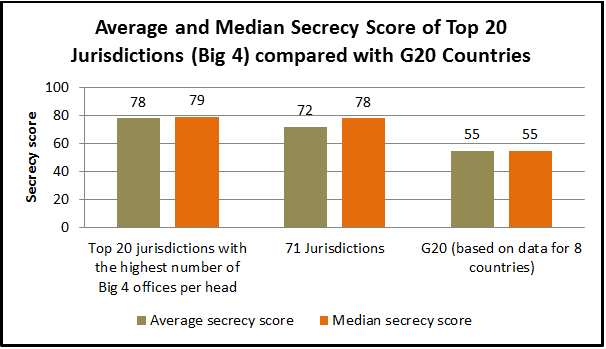
Similarly, we find that comparing the secrecy score of the 20 worst tax havens with the Tax Justice Network's broader list of 71 tax havens and with the G-20 nations shows a much higher mean and median secrecy score in the tax havens than in the non-havens, as the next graph shows.

https://blogger.googleusercontent.com/img/b/R29vZ2xl/AVvXsEhZnT2jbQY6n51pgIgpOtlOTiRuy39dwownX665qsowutrdorJrviwQ2WPyPHnsD7cTmEMWObInspW9TqYP6Vzf_2TiNd6u0Auvwr9MR9ZEAfThCIBUDRryn3_UEwbpDrEWTcCT7JX2/s1600/16.10-2.png
Source: Tax Research UK

As Richard Murphy, one of the authors of the report, comments at Tax Research UK:
This research lets us conclude that working in conditions of secrecy has become an inherent part of the work of bankers and accountants. It suggests that this has led to a culture of creative non-compliance with laws and regulations, which is likely to increase the potential for, and volume of, crime. At the same time, banks’ and Big 4 firms’ lobbying for laws and regulations that reduce transparency is likely to have resulted in further opacity in the world’s financial system.
This, then, is the world in which Mitt Romney travels, a world in which accounting firms actively seek to create tax avoidance opportunities with little concern for whether they step outside the law's boundaries, and in so doing facilitate the transfer of the tax burden from the 1% to the 99%. In my opinion, PwC's assurances about Romney's tax situation are not worth the paper they're printed on.

Bonus question for President Obama to pose in the third debate: Why is the "McCain precedent" (2 years of tax returns) more important to you than the George Romney precedent (12 years of returns)?

Wednesday, October 17, 2012

Fortune 500 Deferring $433 Billion in Taxes

According to a new report today from Citizens for Tax Justice, the 285 members of the Fortune 500 that have parked money overseas would owe an estimated $433 billion in taxes if and when it is repatriated. No wonder these companies are working so hard to get a "repatriation holiday" even though the one given in 2004 did not yield  any significant new investment, but lots of dividends and stock buybacks.

The new report list 10 companies with $209 billion parked overseas that report the taxes they would owe on these profits (only 47 do so). These companies all report that they would owe 32-35% on their money, which indicates they have not paid any taxes abroad on it; in other words, the money is in tax havens.


Note that some estimates place these figures even higher; in March, I reported that Apple's overseas stash was estimated at $64 billion.

Based on the entire 47 companies that report their estimated tax bill, CTJ came up with an average tax rate of just over 27%. Multiplied by the $1.584 trillion in overseas cash held by the 285 corporations (up from about $1 trillion estimated in March) yields the figure of $433 billion in taxes that would be due if the income were repatriated or the deferral provision for overseas income ended.

What does it all mean? As U.S. companies continue to enjoy record profits, they are declaring them to be foreign profits at a high rate, as we can see in the increase from the March to October estimates. Numerous tech and financial companies have stashed literally tens of billions of dollars, each, in offshore tax havens, which drain billions a year from tax coffers that must be made up with higher taxes on the middle class, larger budget deficits, or cuts in programs. And as we have seen from the two tax returns Mitt Romney has released, there is one tax system for the 1% and another one for the rest of us.


Thursday, October 4, 2012

Romney Tax Plan as Budget Busting as Ever

Seriously, I could just re-post my February 27th post word for word tonight and it would be just as true as it was then. The Romney tax plan blows a $5 trillion hole in the budget via tax reductions and he still hasn't told us anything about the tax breaks he would get rid of to pay for it, which he has to do because he calls it revenue neutral, as he did again in tonight's debate.

Amazingly, Romney kept denying that his tax reductions reduce revenue by $5 trillion over 10 years when considered by themselves, even accusing the President of lying about it! He kept insisting that his plan was revenue neutral and that he would not adopt a plan that would reduce the share of taxes paid by the rich. Trust him. We have his word on it.* (Apparently, that is how CNN does fact-checking.)

Given his insistence on his proposal's revenue neutrality, let me repeat my 5-step plan, "How to Read a Republican Tax Proposal."

Step 1: Assume revenue neutrality.
Step 2: Look at what income is no longer taxed.

In the Romney plan, according to conservative economist Josh Barro, there is a $1 trillion reduction in corporate income tax, $3 trillion from the 20% reduction in tax rates (again, not 20 percentage points: the top rate falls from 35% to 28%), and $1 trillion from miscellaneous tax reductions, notably abolishing the Alternative Minimum Tax.

Step 3: Determine how much of that income you have.
Step 4: Ask what taxes have to be raised to get to revenue neutrality.
Step 5: Look in the mirror to see who pays them.

That would be the end of the story, except that the Romney budget is also raising military spending by $2 trillion, as the President pointed out in the debate. So that has to be offset, too.

Again, the bottom line is that if we cut taxes for the wealthy and corporations, it will impact the budget elsewhere, in some combination of tax increases on the middle class, program cuts, and deficit increases. Regardless of the spin surrounding it, if a proposal reduces some taxes but doesn't reduce your taxes, you will lose out via these three methods of compensating for the lost revenue.


* If you aren't old enough to remember, this is a reference to a great series of Isuzu car and truck ads featuring "Joe Isuzu," whose signature line was "You have my word on it."

Wednesday, September 26, 2012

Mitt Romney's Unintentionally Hilarious Tax Return FAQ

Unless you've been in a coma, you have certainly heard about Mitt Romney's release of his 2011 tax returns last Friday. You no doubt know that he and his wife did not claim all the charitable tax deductions they were due, so their tax rate would not go below 13% of adjusted gross income. If you read Bloomberg or a newspaper that picked up the Bloomberg story, you know that Rafalca, the Romneys' dressage horse, has disappeared from their 2011 tax deductions. This, of course, raises the question of whether it was a legitimate deduction in 2010 (or earlier?). After all, being in the Olympics probably raised the mare's value, making the profit motive necessary for an allowable business deduction more plausible. So why would Rafalca not be eligible to deduct in 2011 if she were eligible in 2010 and probably gained value?

But have you read the Frequently Asked Questions page the Romney campaign put up about the 2011 returns and the PricewaterhouseCoopers (PwC) summary of the Romneys' 1990-2009 taxes? You should, for the humor value, if nothing else.

In question 9, we learn how PwC calculated the average effective tax rate: they added the tax rate for each year, then divided by 20. This tells us almost nothing, as many observers (here's one, h/t Think Progress) have pointed out: $50 million taxed at 10% (though the campaign claims it was never less than 13.7%) and $5 million taxed at 30% would yield an average tax rate of 20%, using the PwC method, when the true tax rate would be 11.8% ($6.5/$55) in this example.

In the very next question, however, we learn that for the total of federal taxes, state taxes, and charitable contributions (38.49%), PwC used the proper averaging methodology! In other words, adding up all the payment dollars and dividing by the total adjusted gross income (though we don't know what tricks he used before adjusted gross income). Why didn't they do that for tax alone?

In 2011, the Romneys' charitable contributions came to just over twice their federal income tax ($4 million vs. $1.9 million). If that ratio applied for the entire 1990-2009 period, that would make the federal tax portion less than 13% (even lower because I have ignored state taxes). Of course, we have no way of knowing the real rate for federal or state taxes, or charitable deductions, without seeing the actual tax returns.

But wait, there's more! Don't forget all the offshore accounts! To do this question and answer justice, I'll have to quote it in full:

12. There are some investments that seem to be established in offshore accounts, like the Cayman Islands and Bermuda. Are these investments evading taxes?

Note the misdirection in the question, "evading" rather than "avoiding" taxes, which describe illegal and legal maneuvers respectively. Few people think Romney has broken the law, though Nicholas Shaxson considers it to be a possibility.


No, the investments by the blind trusts in funds established in the Cayman Islands or other jurisdictions are taxed in the very same way they would be if the shares were held in the US rather than through a Cayman fund.  No taxes are evaded or reduced.  These funds are all registered with the IRS and report all income to investors and the IRS, just like domestic funds.  Whether in Bermuda or Boston or elsewhere, there is no difference in how they are taxed.

If this were true, why would the funds need to be organized in the Cayman Islands? Boston would be a lot more convenient. No, as Richard Murphy of Tax Research UK told me, these funds are set up to allow round tripping by U.S. investors to avoid U.S. taxes, though some foreigners may also take advantage of them. Moreover, if foreigners are exempt from U.S. taxes like the Unrelated Business Income Tax, what need do they have to invest through the Caymans except to avoid taxes at home? Finally, we know from the Gawker revelations that at least two Cayman funds the Romneys invested in created five blocker corporations, which are set up precisely to allow round-tripping by Americans. How can these funds be established in the Cayman Islands, etc., for any reason other than tax avoidance?

In addition, it is important to note that there are no offshore accounts.  These are investments in funds that are organized outside the US.

A fund organized in a secrecy jurisdiction like the Caymans, Bermuda, or Luxembourg is offshore by definition.

Further, it is important to note that Governor Romney did not make these investments.  Governor and Mrs. Romney's assets are managed on a blind basis.  They do not control the investment of these assets. The assets are under the control and overall management of an independent trustee.

We've known since 1994 what Romney thinks of blind trusts, calling Senator Ted Kennedy's "a ruse."

Finally, the trustee did not choose where the investments were located any more than a stockholder in a Fortune 500 company chooses where that company is organized.  Only the sponsor of the fund decides where it is organized. That responsibility is totally outside the control of a passive investor like Gov. Romney or the trustee of his blind trust.

And a stockholder can sell his shares. Has trustee Brad Malt never heard of "divestment"? I was one of thousands of people active in the late 1970s to get our universities to sell stock in companies doing business in South Africa, the "divestment movement." While we weren't very successful at Princeton, students and faculty at many other universities were, and some major local government funds divested from such firms, too, leading companies like Citicorp to end their South African operations. Malt could sell if he wanted to.


The bottom line is the "same as it ever was," one tax system for the 1% and another one for the rest of us.

Wednesday, September 12, 2012

UBS Whistleblower's Award Reminds Us Romneys Banked at UBS

Yesterday, the lawyers for Bradley Birkenfeld, the whistleblower in the Union Bank of Switzerland (UBS) tax evasion case, announced that he had received a reward of $104 million from the IRS, its largest-ever whistleblower award. Birkenfeld's ripping away the curtain of Swiss bank secrecy led to $5 billion in extra revenue for the U.S. government, including $780 million from UBS itself, which admitted helping thousands of Americans illegally evade taxes. Not only that, UBS turned over the names of 4500 American clients, and a subsequent amnesty program for Americans with foreign bank accounts in 2009 pulled in another 3000 names (via Matt Yglesias) as of shortly before its deadline. Many more have come in under 2011 and 2012 versions of the amnesty.

The big question behind all this is whether Mitt Romney took advantage of the 2009 amnesty, as Yglesias (link above) suggests. While John McCain saw 23 years of Romney's returns and said there was "nothing disqualifying" in them, he would not have seen Romney's 2009 return. This strengthens the circumstantial case that Romney wants to hide something from that year. So does the fact that Governor Romney declared a Swiss bank account in the one tax return he has released, 2010. Most important of all, the Swiss bank account ($3 million of Ann Romney's blind trust) was at UBS.

Given that the Obama campaign has said that five years of tax returns would be enough, one has to wonder just what could be so awful in his 2005-2009 returns that he still refuses to release them despite all the flak he has gotten over it. I can only think of a short list: tax rate under 13% one or more years, especially 0 federal taxes owed; penalties for under-reporting in prior years; the 2009 amnesty.

Oh, and one more: if his UBS account was one of the 4500 turned over to the IRS by UBS.

Have I missed any?

UPDATE: I see Linda Beale is thinking along the same lines I am.

Tuesday, August 28, 2012

Hilarious twist on "You didn't build that!" UPDATED

The Atlantic Wire (via @NoBigGovDuh) has a great story on the dishonesty of Mitt Romney's "You didn't build that" ads. It turns out that at the Republican convention on Tuesday night, they plan to ramp it up again with a speech by a small business owner from Delaware, Sher Valenzuela, telling everyone how she did build it, not government.

Only one small problem. Actually, two.

First, Valenzuela's business, First State Manufacturing, "received more than $2 million in federal loans and more than $15 million in federal contracts over the years," according to the article. This included Small Business Administration money very early on, as well as federal disaster relief loans after 9/11 and loans from the American Recovery and Reinvestment Act. So, beyond the fact that she obviously didn't build the roads and bridges and other infrastructure--which the President was actually referring to in his speech Romney has so grossly twisted in his ads--she benefited mightily from more direct government aid. Even a month ago, we knew that lots of companies Romney promoted with this tagline actually had gotten direct government support, too.

Second, a fast-thinking Redditor figured out that Valenzuela had not claimed www.firststatemanufacturing.com for her website, and constructed his own parody of her there (h/t @NoBigGovDuh and Atlantic Wire). On the landing page we see Valenzuela displayed next to the words:


This refers to the company's designation by Delaware in 2000 as a Disadvantaged Business Enterprise. As the "About" page concludes,
First State Manufacturing is proud of our heritage, and thankful for the help that government has given us along the way. Not to mention the current help government provides! We believe that to say otherwise would be ungrateful, hypocritical, and unpatriotic.
  We'll see on Tuesday night.

(For the humor-challenged out there, remember, this is not her site and not her words. It's a parody.)

UPDATE: Here is something from Valenzuela's own website: "Get federal dollars by being a minority-owned business." Hypocrisy, anyone?

Friday, August 24, 2012

Lid Blowing Off Romney Tax Secrecy

Gawker (via Eman at Daily Kos) dropped a bombshell yesterday when it released over 950 pages of confidential documents from 21 Bain Capital-related investment vehicles, all of which Mitt or Ann Romney invested in. It made all 48 documents into a single searchable one here so that others could take a look and see what nuggets it might contain.

Romney previously claimed that his Cayman Island funds had to be located there in order to attract foreign investors, who invested via the Caymans so they would not be subject to U.S. taxes on their earnings, and that he did not reduce his tax bill as a result of his Cayman holdings. The newly released documents confirm that among these 21 funds, two set up a total of five so-called "blocker corporations" which allow U.S. non-profit entities to legally pretend to be foreign (i.e., Cayman) corporations in order to avoid the 35% "unrelated business income tax, which was created to prevent nonprofit groups from undertaking profit-making ventures that compete with taxpaying companies," as the New York Times reports. The still-unanswered question is whether Romney's huge 401-k, valued between $20 million and $102 million on financial disclosure forms, is one of the entities that invested in a blocker corporation, which would then refute Romney's assertion that his Cayman investments had not reduced his tax.

The two Bain funds with blocker corporations are Bain Capital Asia Fund LP (mentioned in the Times article; 3blockers) and Bain Capital IX Coinvestment Fund (2 blockers).

A second issue that has been raised is that various Bain entities converted management fees to carried interest (via Ryan Grim). While people know that the carried interest loophole (which makes management compensation into capital gains) exists and is legal, the issue raised by Professor Victor Fleischer of University of Colorado Law School is that private equity firms have come up with a way to make fees that are unarguably management fees subject to ordinary income (35% tax) into capital gains (15% tax) by "waiving" the fees in exchange for virtually certain future profit, so that the extremely slight economic risk is disproportionately small compared to the tax gain. Fleischer argues that this is flat out illegal and concludes: "Mitt Romney has not paid all the taxes required under law." Not all experts agree. We can look forward to more argument on this issue in coming days. Even if it is legal, it is morally even less defensible than the carried interest loophole.

In the end, we are still left with the fact that the tax system for the 1% is different from that for the rest of us.  Whether Romney releases more tax returns or not, that issue is not going away. And the drip, drip, drip of new information makes me think he will eventually cave in.

Cross-posted with Angry Bear.

Tuesday, July 24, 2012

Will Mitt Romney Release More Tax Returns?

Results are in for my reader's poll on whether Mitt Romney would release more tax returns. The overwhelming majority, 72%, said no, while 18% said yes, and the other 10% were unsure.

I'm in the 18% who said yes. I think that the President will keep up the pressure on Governor Romney over this issue, and it's easy to  imagine him bringing it up in the debates in a forceful manner. "You're running for President of the United States and you think you don't have to release your tax returns like everyone else? Get serious!" But we'll know by November.

To update my last Romney post, his campaign is now denying that Governor Romney took part in the IRS amnesty program over unreported accounts in 2009, according to CNBC (via Talking Points Memo). We have their word on it...

Wednesday, July 18, 2012

Is the Noose Closing Around Romney's Tax Returns?

Problems on my blogging computer have kept me away from here for a week, and a lot sure has happened on the Mitt Romney tax story in that time. The Obama campaign has gone after Romney on his tax havens and tax returns is two separate television ads, including a new one yesterday. Calls have mounted from Republicans for Romney to release his tax returns, yet as of last night Romney was standing firm that he would not release any besides 2010 and (so-far estimated) 2011. The most interesting development to me is that speculation on what could possibly be so bad in the returns is narrowing down to one year, 2009.

Dan Shaviro (via TaxProf Blog) makes three points:
1) We know from the 2010 tax return, in which he had a net capital loss carryforward from 2009, that he zeroed out his net capital gains - including from carried interest Bain income - in 2009.

2) 2009 was the last year in which he received certain Bain payments as the playout of his "retroactive retirement."

3) It's been hard to understand what benefit he thought he was getting from the Swiss bank account, and there was an IRS amnesty program in 2009 for fraudulent nondisclosure of offshore income.  If he had to come clean in 2009, this might be embarrassing, especially given that there was an iron fist inside the IRS leniency offer (i.e., if you held out, they might get you without any amnesty).
So it is possible that Romney had a high income, but an even lower tax rate in 2009 than 2010--maybe even zero. The other possibility is that he got caught up in having an undeclared offshore account and took the IRS amnesty in 2009.

Matthew Yglesias also thinks the IRS amnesty program could be the answer:
Failing to apply for the amnesty and then getting charged by the IRS would have been both financially and politically disastrous. So amnesty it was. But even though the amnesty would eliminate any legal or financial liability for past acts, it would hardly eliminate political liability
Wouldn't it be great if we knew which Swiss bank Romney's money had been hidden in? As you may know, the IRS nailed Union Bank of Switzerland (UBS) for helping Americans commit tax evasion (the illegal kind, as opposed to legal tax avoidance). As a result, UBS coughed up the names of more than 4400 Americans (out of 52,000 originally sought by the IRS) who had accounts there. This was the backdrop to the IRS amnesty: for the first time, the U.S. had breached Swiss banking secrecy and Americans with Swiss bank accounts could no longer be sure that their secret was safe.

In fact, we do know which bank held $3 million of Ann Romney's blind trust. It was UBS.

How do we know? Brad Malt, the Romneys' trustee, said so. Not only that, when Romney released his 2010 tax return in January of this year, he had to amend two previously filed disclosure forms, for 2007 and 2011. In 2007, he had not specified that the UBS account was in Switzerland, not the U.S., according to ABC News (UBS has branches in the U.S.).

Let's review the bidding: Ambiguous disclosure in 2007. UBS income on 2010 tax return. Retroactive revision of 2007 disclosure. IRS amnesty for undisclosed foreign accounts in 2009 powered by UBS prosecution. Refusal to release 2009 tax return. Yes, 2009 could be a big problem.

Also, as Linda Beale points out, it would be great to see 1999-2002 to help sort out the Bain claims and counter-claims.

The entire tax return saga is emblematic of a much larger issue: How there is one set of rules for the 1%, and a different one for the rest of us. If the consequences of releasing his returns would be so much worse than the sustained onslaught Romney is already absorbing, I have to question whether Romney can even finish the race.

Thursday, July 5, 2012

What is Mitt Romney Hiding? UPDATED

Mitt Romney has so far released only one year of tax returns (2010), plus an estimate for 2011. This stands in stark contrast to his father, Michigan Governor George Romney, who released 12 years of tax returns when he began running for President in 1967. As his father said at the time, "One year could be a fluke." So the questions remain about what is in Romney's older returns.

Two stories this week and last have ratcheted up the pressure. One is a recent web exclusive for "The Last Word with Laurence O'Donnell" where David Cay Johnston has five questions for Romney that can only be answered with his tax returns. The other is a blockbuster story by Nicholas Shaxson (h/t TPM) in the new Vanity Fair on the shadowy world of Romney's tax havens. Together, they put a laser-like focus on the finances of the man who could become our 45th President.

Johnston is a well-known former New York Times reporter, Pulitzer Prize winner, and the author of the major books Perfectly Legal and Free Lunch. If you don't have time to watch his 3:45 video, here are the five questions:

"1. Did you buy any illegal or gray area tax shelters?
"2. Did an IRS audit ever uncover serious problems with any of your tax returns?
"3. Did you make use of offshore vehicles to defer, or avoid paying, federal income taxes?
"4. Did you take advantage of any tax strategies that the IRS did not uncover in audits?
"5. Did you fully tithe to the Church of Jesus Christ of Latter Day Saints every year and take a deduction on your tax return that shows that?"

These are important questions. We know that Governor Romney has had a Swiss bank account, as well as money in other tax havens like the Cayman Islands, Luxembourg, Bermuda, and Ireland. Romney's answer to any question about his taxes has basically been, "Trust me." But the guy's running for President, for Pete's sake. He owes us more than that.

Shaxson, a researcher for the Tax Justice Network and author of the book Treasure Islands, asks us to consider the possibility that maybe not everything Romney has done tax-wise has been  legal. He opens with a story told by a former Bain employee about how Romney encouraged him to lie to get secret information on competitors. There is, of course, the fact that Romney has funds parked in numerous tax havens and the fact that his supposedly "blind" trust invested in a business started by Romney's son Tagg, and the fact that he has $102 million in his IRA despite a contribution limit of $2000 per year for the entire 15 years Romney ran Bain. Obviously nothing to see here...

The standard answer of the Romney campaign to all this is that he always followed the law. As Jon Stewart had to point out since the major media did not, Romney did plenty to affect the law he was supposedly "just following," including his defense of the "covered carried interest" tax loophole that let him treat his fees at Bain as if they were capital gains (15% tax) rather than wages (35% tax). All perfectly legal and as Johnston points out in his book by that name, that is the real scandal.

Further, Shaxson reveals that an early filing of the original Bain Capital fund in 1984 showed that many of its foreign investors were routed through tax havens and that at least one was a notorious financial criminal, Robert Maxwell. Thus, Bain helped foreigners take advantage of the fact that the United States has set itself up as a tax haven for non-citizens (see also Jason Sharman's paper on setting up anonymous companies in the U.S. and elsewhere; h/t Robert Kudrle). Shaxson quotes Rebecca Wilkins of Citizens for Tax Justice, “It is shocking that a presidential candidate should think that is O.K.” for Bain to service the likes of Robert Maxwell.

The bottom line is that there is a lot of unsettling information in what investigators have so far been able to piece together about Romney's finances. The easiest way for Governor Romney to put to rest what his campaign described to Shaxson as "unfounded allegations and insinuations" would be to release his tax returns. Yet he has not done so and shows no sign of changing his mind. Josh Marshall calls the questions "kryptonite" and thinks Romney will come under a lot of pressure to release more tax returns. Let's hope so. The guy's running for President, for Pete's sake.

Updated to correct "covered interest" to "carried interest." Thanks to m.jed at Angry Bear.

Update 2: Via Gotta Laff at The Political Carnival, here is a Wall Street Journal video covering the low-valued special class of shares that Romney and other Bain executives put into their IRAs, which tends to bolster Shaxson's contention that this is the source of the huge gains in Romney's IRA. (As opposed to the suggestion of some commenters that he rolled over other types of income into his IRA when he left Bain.) The key question from a tax law perspective is whether these shares were properly valued.

Friday, May 25, 2012

Romney to Replace Obamacare with...Essentially Nothing

Tommy Christopher (via @rcooley123) at Mediaite has a good catch on Mitt Romney's health care proposals, from an interview Romney gave to Mark Halperin of Time magazine. Asked what would happen to people with pre-existing conditions after he were to repeal Obamacare, Romney said:
If people have been continuously insured, and then they decide to change jobs or change locations, they should not be denied coverage if they go to a new place or have to get a new policy. So people continuously insured should be able to get new insurance.
As Christopher points out, people who have been continuously insured already have this right, and have since 1996, under Title 1 of HIPAA. As he puts it, Romney "is selling you something you already owned." And lest you think maybe Romney just misspoke, you can see the very same words in his platform: "Prevent discrimination against individuals with pre-existing conditions who maintain continuous coverage." So, on the critical question of pre-existing conditions, Romney is offering precisely nothing.

That is hardly the end of Romney's useless ideas on health care. His platform says we should return control over health insurance to the states. In principle, this could be workable; after all, in Canada each province has its own health insurance plan. States are big enough entities to do this: if Prince Edward Island can have its own plan, so could Rhode Island. And there is diversity in the provincial plans: Quebec's covers prescription medicine, while Ontario's does not. But this only works because the federal government has strong conditions on what level of coverage the provinces can provide. Romney, on the other hand, says we should "Limit federal standards and requirements on both private insurance and Medicaid coverage." This is a sure recipe for bad health insurance regulation at the state level.

Another plank in his health care platform is to "Empower individuals and small businesses to form purchasing pools." This will not enable individuals or small businesses to have anywhere near as much bargaining power as the state insurance exchanges in the Affordable Care Act.

Romney also says we should turn Medicaid into a block grant, giving states more flexibility. As Aaron Carroll points out, states acquired a great deal of flexibility with Medicaid during the GW Bush Administration, but have not introduced any great innovations. Why Romney thinks that would change is anyone's guess.

And of course, what would a Republican health care proposal be without the usual references to tort reform, "innovation grants to explore non-litigation alternatives to dispute resolution" (tort reform again), allowing insurance to be sold against state lines (which would weaken state's ability to regulate; isn't that where Romney said authority should be?) and getting rid of the tax deduction for employer-provided health care?

So, instead of the Affordable Care Act, Romney promises to give us what we already have on pre-existing conditions, plus junk to give insurance companies even more control over the health care market than ever.

Wednesday, May 16, 2012

Another Romney/Bain Firm Got Subsidies (Then Closed a Plant)

The Tampa Bay Times reports (via Jed Lewison) that another Bain-owned company, Dade Behring, was a recipient of $7.1 million in subsidies from Puerto Rico and the federal government the year before it laid off 300 workers there. A common problem with many subsidized projects, it took the money and ran without any consequences.

As I have pointed out before, another Bain-owned company, Steel Dynamics, received at least $95 million in incentives from state and local governments in Indiana, for two separate investments. In fact, this exceeds the $85 million Bain made in profit from the firm.

Now we have a third example of Bain-owned companies getting government subsidies. For a candidate who claims to be about private enterprise, Romney clearly doesn't walk the walk. As Jed Lewison has noted before, it's clear that when Romney talks about crony capitalism, he's talking about himself.

How many other government subsidies are in Bain's past? Inquiring minds want to know.

Wednesday, March 28, 2012

Romney Gets Incoherent on Pre-Existing Conditions

Mitt Romney was on the Jay Leno Show last night (via @didkins4life) and gave a completely incoherent account of whether people with pre-existing conditions should be able to get insurance. As the author of Massachusetts' health insurance reform as Governor, he was able to articulate the free-rider problem of people waiting to get sick to get insurance--which is why Romneycare and the Affordable Care Act have an individual mandate.

But Romney stumbled badly when Leno asked him what should happen to people with pre-existing conditions. If they had had insurance before, Romney said they should be able to get it again. (Note, however, he says nothing about how long ago they'd had insurance.) But if they never had insurance before, Romney gave what was essentially a non-answer: a) You can't play games like that; b) "But you have to find rules that get people in that are playing by the rules.” That, of course, would be a mandate, but he can't bring himself to say it because of primary politics and, as Greg Sargent points out, perhaps his own beliefs as well.

The alternative, though, is to do nothing for the uninsured who get sick. Romney did not rule that out, but merely tried clumsily to finesse it. As Mark Thoma says,
If we could make people pay the full cost of this wager that they won't need insurance, i.e. if society could turn it's back and say you made your choice, now live (or die) with it, a mandate wouldn't be needed. But we can't (and I wouldn't want to live in a society that could).
 I wouldn't want to live in such a society, either, which is why we need universal coverage. Though I'd prefer single payer, right now the Affordable Care Act's individual mandate is as close as we are going to get. Romney's repudiation of it is as hilarious (and depressing) as that of the Heritage Foundation. As a result, his plans for the uninsured look distressingly like what Alan Grayson called the Republican health plan: 1) Don't get sick. 2) If you do get sick, die quickly.

Wednesday, February 22, 2012

Romney Tax Plan Blows Hole in Budget, Remains Short on Specifics

Mitt Romney unveiled his tax plan today, but it revealed few surprises except for surprisingly few specifics. Via Chris Hayes (@chrislhayes), conservative economist Josh Barro estimates that the Romney plan consists of $5 trillion in tax cuts over 10 years, divided as follows:

$1 trillion from cutting the corporate income tax
$3 trillion from cutting all personal income tax rates by 20% (not 20 percentage points, by the way)
$1 trillion from miscellaneous tax cuts like abolishing the alternative minimum tax (AMT)

According to the Romney plan, the corporate income tax rate would fall from 35% to 25% and the U.S. would stop taxing countries on their foreign profits. Contrary to Romney's claim, making foreign profits tax-free would not encourage their investment in the U.S., but would instead give companies an incentive to make more of their profits appear to be foreign by creative use of transfer pricing to make profits show up in tax havens instead of the U.S. Under the Romney plan, companies would then be free to bring that money back to the U.S. without facing any tax, anywhere in the world.

Among the other non-surprises in the plan, Romney would not increase the 15% tax rate on his own main source of income, capital gains. He would repeal the Affordable Care Act, even though his version of it in Massachusetts gave the state the highest level of insurance coverage in the country at 95%. He would raise the eligibility age for Social Security and end Medicare as we know it a la the Ryan Plan, two staples of conservative talking points that would negatively affect the middle class.

As Barro points out, Romney has said before that he will increase American military spending (already tops in the world by far). This makes it even more difficult for him to offset the $5 billion in tax cuts without huge cuts to programs that the middle class depends on. Thus, I think the inescapable conclusion is that of Benjy Sarlin: "Romney's Tax Plan Still a Boon to the Rich, Despite 1% Talk."

Wednesday, January 25, 2012

Jon Stewart Delivers the Goods on Mitt Romney's Taxes

Mitt Romney claims to simply have been following the law in how he paid his taxes for 2010 and 2011. As we have seen, he was able to use the carried interest loophole (taxing hedge fund managers' fees as if they were profits and therefore subject to the 15% capital gains rate rather than being ordinary income) to reduce his tax rate below 14%. But how is that loophole still in existence, despite a bipartisan effort to kill it in 2007?

Building on a recent New York Times story*, Jon Stewart spilled the beans on Romney tonight. On "The Daily Show" (via Mediate, h/t @Phostir), Stewart poses and answers that question. Starting at 3:27 into the clip, Stewart notes Romney's claim to be simply following the tax laws as written. He hows a 2007 video of co-sponsor Sen. Charles Grassley (R-Iowa) talking about how heavily lobbied it was. At 4:51, Stewart answers the question of who was fighting repeal: The Private Equity Council, started in 2007 by, among other firms, Bain Capital. He then plays a clip of Romney himself telling a TV reporter he "doesn't think it's a good idea to raise taxes" in response to a question about this bill.

What Stewart has laid bare for all to see, of course, is exactly how much influence Romney had on the laws that today he claims simply to be following. I'm shocked, shocked... Occupy Wall Street proven right once again.


* "As Romney Campaign Advances, Private Equity Becomes Part of the Debate," NYT, Jan. 11, 2012, p. A17, via Lexis-Nexis Academic.

Friday, January 20, 2012

Romney's Cayman Explanations Don't Tell the Whole Story, Says Tax Haven Expert

Brian Beutler at Talking Points Memo has a story purporting to tell us the "real deal" on Mitt Romney's investments in secret Cayman Island corporations. Surprising, given the ABC News (which originally broke the story) and Wall Street Journal articles he links to, Beutler nowhere mentions that these accounts are secret, in accordance with Cayman Islands bank secrecy provisions, which are some of the toughest in the world.

Worse still, Beutler gives the impression that there is nothing unusual about Romney's use of these accounts. He writes:
The offshore funds story is about a strategy investors use not to defer income and reduce their tax burden, but to attract foreign investors who want to avoid U.S. taxation.
“One of the reasons to have a Cayman Islands entity is so that foreign investors will not get hit with U.S. income, and that’s consistent with our general tax policy,” says Victor Fleischer, a tax professor at the University of Colorado Law School. This can give American investors who offshore a competitive advantage over those who don’t, and can cost the Treasury revenue, but it’s on the level.
 I contacted Richard Murphy, head of Tax Research UK and an internationally known expert on tax havens. He called this argument "ludicrous."
Remember, there is nothing of significance  in Cayman, and no money of any significance is made in Cayman. Nor is there indigenous wealth. So all money coming into the US from Cayman came from somewhere else. Now where is the most likely source? I'll wager it's the USA. So money flees illicitly out of the US to Cayman so it can come back in a supposedly tax free structure - that's called "round tripping." Not all is that way - some will come from South America and very little from Europe - wrong time zone  - but the sole reason for Cayman secrecy is mainly to hide the round tripping and that's the most venal tax sin. So to argue that you're luring money in requires you to lure money out of somewhere first - and there's the weakness in the argument presented - precisely because that dimension of the story is ignored in all the reports on this issue.
 In other words, following this logic, if Romney (and Bain) secretly put millions of dollars into the Cayman Islands to attract funds into the U.S., as he has claimed, he's ignoring or not saying where he thinks those funds came from, and that's the weakness in his position. It's at least possible that those funds were round tripping as Murphy suggests, and in that case the so-called foreign investment is in fact just U.S.-based investment repackaged to look like foreign investment with all the tax advantages that attach to that.

The round-tripping phenomenon is well-known in China, where Chinese investors put money into a Hong Kong or other location, and then send the money right back to China so it can claim subsidies not available to domestic Chinese companies.It's entirely possible that U.S. citizens have done the same using the Cayman Islands, and Romney does not appear to be addressing that issue.

Amazingly, the Romney camp claims that the Caymans are not a tax haven. Beutler's article misses the entire round-tripping aspect and focuses too much on legality. While at present there is no indication that he broke any laws, Romney's actions highlight that there is one tax system for the 1%, and a different one for the rest of us. As David Cay Johnston put it, the real scandal in U.S. tax law is what is "Perfectly Legal."

Sunday, January 15, 2012

Mitt Romney's Steel Dynamics Took Subsidies Not Once, But Twice, Under Bain's Ownership

Mitt Romney touts the virtues of free markets and the dangers of government intervention, yet when Bain Capital became the largest owner of Steel Dynamics in 1994, the company was already looking for state and local incentives for its first plant in DeKalb County, Indiana, according to the Los Angeles Times (h/t Jed Lewison). The same month Bain invested $18.2 million in the company, June 1994, state and local governments in Indiana approved a $77.84 million incentive package after months of negotiations with the company (Fort Wayne Journal Gazette June 23, 1994, via Nexis, h/t Phil Mattera).

The Steel Dynamics subsidy story doesn't end there, however. Four years later, while still owned by Bain Capital, the company got $18 million in local tax incentives for a structural steel mill in Whitley County, Indiana (AP State & Local Wire, October 21, 1998, via Nexis).

Even after Bain cashed out with an $85 million profit, the company continued its subsidy seeking ways, getting state tax incentives and training grants for an expansion in Indiana in 2005 (M2 EquityBites, December 1, 2005, via Nexis), a $52,886 property tax break in Continental, Ohio, in 2007 (Toledo Business Journal, February 2007, via Nexis), and other deals.

The Bain Capital subsidy saga does not end with Steel Dynamics. Phil Mattera of Good Jobs First has the best rundown, covering a total of nine companies Bain owned, including Sealy Mattress, which received $600,000 to move from Ohio to North Carolina.

As Jed Lewison points out, when Romney talks about "crony capitalism," he ought to be talking about himself. Steel Dynamics has from its outset been a subsidy-generating machine, and Bain dove right into it.