If you've enjoyed my posts, you may be interested in my courses, too. In spring 2013, I will be offering an online course at the advanced undergraduate level in my specialization, international political economy (Political Science 3830). This course will examine the main issues of the global economy, including trade, money, investment, and globalization, from a variety of theoretical perspectives and a special focus on who wins and who loses from different policies. I have taught this course for over 20 years and am now in the process of finalizing the online architecture.
This is a regular course at University of Missouri-St. Louis and you may be able to transfer it into your own degree program; needless to say, check with your adviser. To do this, you would enroll as a visiting student.
You can also enroll as a non-degree student if you are simply interested in the subject and are not taking it as part of a degree program.
This is a 3 credit-hour course. Tuition is $265.60 per credit hour for Missouri residents and residents of 22 counties in western and southern Illinois. Out-of-state tuition is $717.90 per hour. You will need to check what other fees may apply (there is a supplement for online courses; beyond that, I am uncertain).
If you are interested, you will need to apply as a visiting student or non-degree student. See here for more details on the admission process. Feel free to contact me at kpthomas55@hotmail.com if you would like more information.
Tuesday, November 13, 2012


Monday, November 5, 2012
Bain Capital Avoided $102 Million in Taxes Via Dutch Subsidiary UPDATED
A Dutch newspaper, de Volkskrant, reports today (translation here) that Bain Capital used a Dutch
subsidiary to avoid $102 million on its taxes. This has been picked up
by Taegan Goddard
and the Atlantic Wire.
The Dutch author wrote a comment on Goddard’s site clarifying that Bain
(not Romney) saved $102 million. From his 2010 and 2011 tax returns,
Romney received $2.1 million in dividends and $5.5 million in capital
gains. Of course, who knows what he received in previous years, since
Romney hasn’t released more tax returns?
Since all the original analysis is in Dutch, which I can't speak, it's hard to say much further at this point, though Bain and the Romney campaign predictably refused to comment. However, the report does show the statement for Bain Capital Fund VIII for the first nine months of 2010 (part of the documents leaked to Gawker, I believe). One illuminating nugget on how private equity makes its money is that the fund reported $174,493,175 in income for the nine months, and a staggering management fee of $46,746,696! This makes it easy to see how private equity folks make so much money whether the underlying investment does well or not.
Of course, this is just one more piece of how the 1% hide their money from taxation. With Romney, it's gotten to the point where we are no longer surprised by this anymore.
Where is the mainstream media on this?
UPDATE: Here is a fuller translation from a Dutch speaker at Daily Kos.
Since all the original analysis is in Dutch, which I can't speak, it's hard to say much further at this point, though Bain and the Romney campaign predictably refused to comment. However, the report does show the statement for Bain Capital Fund VIII for the first nine months of 2010 (part of the documents leaked to Gawker, I believe). One illuminating nugget on how private equity makes its money is that the fund reported $174,493,175 in income for the nine months, and a staggering management fee of $46,746,696! This makes it easy to see how private equity folks make so much money whether the underlying investment does well or not.
Of course, this is just one more piece of how the 1% hide their money from taxation. With Romney, it's gotten to the point where we are no longer surprised by this anymore.
Where is the mainstream media on this?
UPDATE: Here is a fuller translation from a Dutch speaker at Daily Kos.
Saturday, November 3, 2012
What Senate Republicans Don't Want You to Find Out
There is a lot of buzz now about the fact, discovered over a month after it happened, that the Congressional Research Service (CRS) had withdrawn one of its research reports due to pressure from Republican Senators. Probably the most commonly used adjectives used to describe the CRS are "respected" and "non-partisan," so what is going on here? The simple answer is that the Republicans didn't like the study's conclusions and complained vociferously to CRS. Why did the CRS give in? No one knows yet, although the New York Times reported:
One major finding is contained in a plot of the top personal income tax rate and real economic growth rates for every year from 1945 to 2010. Contrary to conservative arguments, when the top tax rate was from 70-90+ percent, the country had growth rates averaging 4.2% in the 1950s, but only 1.7% in the 2000s, when the top rate was 35%. Overall, according to Figure 5 of the report, there appears to be no relationship at all between the top tax rate and growth.
It's important to remember, though, that a simple comparison of two variables tells us nothing by itself. It's only when we control for other potential causal factors that we can say whether a relationship does or does not exist between two variables like tax rates and growth. In the report's appendix, the author carries out such a regression analysis, as it's called, and still finds that there is no relationship between the top tax rate and real GDP growth rates.
Moreover, the study takes a look at the ways that lower tax rates are supposed to improve the economy, i.e., by increasing private savings, private investment, and labor productivity growth. In no case does the bivariate analysis (some of which shows higher taxes increasing private savings) or the regression analysis show either the top personal tax rate or the capital gains tax rate having an effect on these intervening drivers of economic growth. This completely undermines the economic arguments for tax cuts as the recipe for a better economy.
But wait, there's more! The diagram (scatterplot) showing the relationship between the top tax rate and the private savings rate shows that the highest private savings rates since 1945 were achieved when the top marginal rate was 70% (see top left of Figure 3), which comports well with recent calculations of the top optimal tax rate (70% or higher). In fact, when the top bracket was 90%, the rate of private savings as a percentage of potential GDP exceeded the rate when it was 40% or below in every year but one!
The other discomfiting finding for the Republican Senators is that lower top tax rates and lower capital gains tax rates increase income inequality. Not only is this obvious in the scatterplots for the top 0.1% and top 0.01%, it remains true in the regression analyses after controlling for other potential causes of the high income shares of the rich.
Tax cuts, then, don't increase economic growth (the ultimate zombie idea, as Paul Krugman says) but do worsen economic inequality. It may even be the case that high top marginal tax rates increase private savings, with the country's historical postwar maximum savings rates coming at a rate of 70%.
What the suppression of this study amounts to, then, is part of the present-day Republican Party's war on science, arithmetic, and knowledge in general. Unable to refute the findings of the CRS report, they demand its censorship instead. As Jared Bernstein says, this is simply scary: "this type of suppression is wholly inconsistent with democracy." That Congress' non-partisan research arm is going along with this makes it especially chilling.
A person with knowledge of the deliberations, who requested anonymity, said the Sept. 28 decision to withdraw the report was made against the advice of the research service’s economics division, and that Mr. Hungerford [the study's author] stood by its findings.What was in the report that terrified Republican Senators so much? In fact, a lot more than reported in the media: "Tax Cuts for the Rich Do Not Spur Economic Growth," Talking Points Memo, September 17; "Tax Cuts for the Rich Cause Income Inequality, Not Economic Growth," Think Progress, September 17; for example.
One major finding is contained in a plot of the top personal income tax rate and real economic growth rates for every year from 1945 to 2010. Contrary to conservative arguments, when the top tax rate was from 70-90+ percent, the country had growth rates averaging 4.2% in the 1950s, but only 1.7% in the 2000s, when the top rate was 35%. Overall, according to Figure 5 of the report, there appears to be no relationship at all between the top tax rate and growth.
It's important to remember, though, that a simple comparison of two variables tells us nothing by itself. It's only when we control for other potential causal factors that we can say whether a relationship does or does not exist between two variables like tax rates and growth. In the report's appendix, the author carries out such a regression analysis, as it's called, and still finds that there is no relationship between the top tax rate and real GDP growth rates.
Moreover, the study takes a look at the ways that lower tax rates are supposed to improve the economy, i.e., by increasing private savings, private investment, and labor productivity growth. In no case does the bivariate analysis (some of which shows higher taxes increasing private savings) or the regression analysis show either the top personal tax rate or the capital gains tax rate having an effect on these intervening drivers of economic growth. This completely undermines the economic arguments for tax cuts as the recipe for a better economy.
But wait, there's more! The diagram (scatterplot) showing the relationship between the top tax rate and the private savings rate shows that the highest private savings rates since 1945 were achieved when the top marginal rate was 70% (see top left of Figure 3), which comports well with recent calculations of the top optimal tax rate (70% or higher). In fact, when the top bracket was 90%, the rate of private savings as a percentage of potential GDP exceeded the rate when it was 40% or below in every year but one!
The other discomfiting finding for the Republican Senators is that lower top tax rates and lower capital gains tax rates increase income inequality. Not only is this obvious in the scatterplots for the top 0.1% and top 0.01%, it remains true in the regression analyses after controlling for other potential causes of the high income shares of the rich.
Tax cuts, then, don't increase economic growth (the ultimate zombie idea, as Paul Krugman says) but do worsen economic inequality. It may even be the case that high top marginal tax rates increase private savings, with the country's historical postwar maximum savings rates coming at a rate of 70%.
What the suppression of this study amounts to, then, is part of the present-day Republican Party's war on science, arithmetic, and knowledge in general. Unable to refute the findings of the CRS report, they demand its censorship instead. As Jared Bernstein says, this is simply scary: "this type of suppression is wholly inconsistent with democracy." That Congress' non-partisan research arm is going along with this makes it especially chilling.
Wednesday, October 31, 2012
Discussing Tax Increment Financing on TV
I recently appeared on a local public access TV show, "Conversation with Lee Presser," discussing tax increment financing and European Union subsidy control regulations. It's a great format, just an almost 30-minute discussion without interruption, which allowed me to explain the problems with TIF as it has been used in Missouri in great detail. We also had a shorter conversation about EU regulations to control investment incentives and other subsidies, which covered the basics of transparency, maximum subsidy rates that vary by how rich the region is, and the reduction in those rates for large projects. Many thanks to Lee Presser for having me on. If you are interested in economic development issues, I think you will enjoy the program.
"A Conversation with Kenneth Thomas - UMSL Professor of Political Science - 10/23/12"
"A Conversation with Kenneth Thomas - UMSL Professor of Political Science - 10/23/12"
Saturday, October 27, 2012
McMahon's WWE has taken $36.7 million in Connecticut subsidies
U.S. Senate candidate Linda McMahon's World Wrestling Entertainment (WWE) has received $36.7 million in Connecticut film tax credits in 20 separate deals since 2006, reports CTPost.com (thanks to Karin Richmond on the LinkedIn Public Incentives Forum). As in many states, what historically began as tax credits for motion pictures are now available for TV and online media as well, and it is in these two latter categories that the WWE received its subsidies. Also as is typical of other states, the Connecticut program has no job creation requirements, but is calculated simply as a percentage of "qualified expenditures," with the rate being 30% in Connecticut. In fact, in WWE's case, the company had laid off about 60 workers in 2009, yet continued to receive the credits.
Moreover, according to the Sacramento Bee blog, "Cageside Seats," WWE has so little state tax liability that it sells the vast majority of its tax credits via a broker, including 93% of the tax credits it earned in 2007-9. While selling tax credits is perfectly legal (in David Cay Johnston's memorable phrase), it also increases the subsidies that states give, because they wind up giving subsidies to companies that did nothing to qualify for them under any subsidy program.
Nor is WWE alone in its sale of Connecticut tax credits. According to a 2010 article at the CT Post, "of the 80 productions that received credits, only nine applied them to state taxes." The rest, presumably, sold their credits via brokers. The article also states that the national tax credit market had reached $500 million annually in 2010, from $50 million per year in 2005.
Robert Tannenwald of the Center for Budget and Policy Priorities (CBPP) has analyzed state film subsidies and concluded they provide very little bang for the buck. This should not be surprising. Unlike most subsidies, film/TV/digital media subsidies do not go to an investment, but to operating costs. There is nothing left after the crew packs up. Tannenwald points out that even the early adopters of film subsidies (New Mexico and Louisiana), which appeared to have built up some in-state film capacity, are now finding it difficult to maintain their position as the number of states offering such incentives skyrocketed to over 40 by 2010. The increased competition has led states to bid up their reimbursement percentages, to over 40% in Alaska and Michigan. Moreover, it's hard to have job creation requirements for jobs that are inherently temporary.
Tannenwald estimates that the 43 states that gave film tax credits in fiscal 2010 spent $1.5 billion. This is enough to hire back 30,000 state workers laid off since the recession began, at an average of $50,000 per year in salary and benefits.
Although not members of the Forbes 400, Linda and Vince McMahon follow their example in collecting millions in subsidies from government. This is particularly hypocritical since as a Senate candidate McMahon has tried to portray herself as an opponent of "corporate welfare."
Besides having little bang for the buck, film subsidy programs have been rocked by scandal in both Iowa and Louisiana, where the film commissioner was convicted of bribery to accept inflated expense submissions. The Iowa Film Office director was convicted of felonious misconduct, but acquitted on eight other felony charges. A number of credit claimants in Iowa were convicted of felonies as well in other trials.
As I have argued before, investment incentives generally constitute a race to the bottom. However, film and related media subsidies have shown us a high-speed race to the bottom for amazingly little economic benefit. While a few states have cut back on the subsidies due to the recession (and Iowa suspended its program for three years due to the scandal), only federal controls can truly address this problem. My research in Canada (paywalled) found the provinces there similarly unable to control their film subsidy wars. At this point, only transparency in program costs, plus information on the low benefits and frequent scandals, is the only way to generate political pressure for reform.
Moreover, according to the Sacramento Bee blog, "Cageside Seats," WWE has so little state tax liability that it sells the vast majority of its tax credits via a broker, including 93% of the tax credits it earned in 2007-9. While selling tax credits is perfectly legal (in David Cay Johnston's memorable phrase), it also increases the subsidies that states give, because they wind up giving subsidies to companies that did nothing to qualify for them under any subsidy program.
Nor is WWE alone in its sale of Connecticut tax credits. According to a 2010 article at the CT Post, "of the 80 productions that received credits, only nine applied them to state taxes." The rest, presumably, sold their credits via brokers. The article also states that the national tax credit market had reached $500 million annually in 2010, from $50 million per year in 2005.
Robert Tannenwald of the Center for Budget and Policy Priorities (CBPP) has analyzed state film subsidies and concluded they provide very little bang for the buck. This should not be surprising. Unlike most subsidies, film/TV/digital media subsidies do not go to an investment, but to operating costs. There is nothing left after the crew packs up. Tannenwald points out that even the early adopters of film subsidies (New Mexico and Louisiana), which appeared to have built up some in-state film capacity, are now finding it difficult to maintain their position as the number of states offering such incentives skyrocketed to over 40 by 2010. The increased competition has led states to bid up their reimbursement percentages, to over 40% in Alaska and Michigan. Moreover, it's hard to have job creation requirements for jobs that are inherently temporary.
Tannenwald estimates that the 43 states that gave film tax credits in fiscal 2010 spent $1.5 billion. This is enough to hire back 30,000 state workers laid off since the recession began, at an average of $50,000 per year in salary and benefits.
Although not members of the Forbes 400, Linda and Vince McMahon follow their example in collecting millions in subsidies from government. This is particularly hypocritical since as a Senate candidate McMahon has tried to portray herself as an opponent of "corporate welfare."
Besides having little bang for the buck, film subsidy programs have been rocked by scandal in both Iowa and Louisiana, where the film commissioner was convicted of bribery to accept inflated expense submissions. The Iowa Film Office director was convicted of felonious misconduct, but acquitted on eight other felony charges. A number of credit claimants in Iowa were convicted of felonies as well in other trials.
As I have argued before, investment incentives generally constitute a race to the bottom. However, film and related media subsidies have shown us a high-speed race to the bottom for amazingly little economic benefit. While a few states have cut back on the subsidies due to the recession (and Iowa suspended its program for three years due to the scandal), only federal controls can truly address this problem. My research in Canada (paywalled) found the provinces there similarly unable to control their film subsidy wars. At this point, only transparency in program costs, plus information on the low benefits and frequent scandals, is the only way to generate political pressure for reform.
Sunday, October 21, 2012
Starbucks in Hot Water Over British Tax
Reuters (via Tax Research UK) reported on October 15 the results of an extensive investigation into the British unit of coffee giant Starbucks, the second largest restaurant firm in the world after McDonald's. It turns out that the company has reported losing money in every one of the 14 years it has operated in the country, even as it tells investors that the unit is profitable. Reuters documented this latter fact by getting the transcripts of 46 investor conference calls Starbucks has made over the last 12 years.
For the last three years, Starbucks has paid no income tax at all in the United Kingdom. This is a textbook case of using transfer pricing to hide your profits from the taxman and make them show up in tax havens instead.
According to the Reuters report, there are three potential routes the company has to make its profitable British subsidiary legally have no tax liability.
1) The British subsidiary pays a Dutch subsidiary for the use of trademarks and other intellectual property of Starbucks, at a cost of 6% of sales as royalties. An undisclosed amount of this barely profitable unit's revenue is paid to another Starbucks subsidiary in Switzerland. Where the money goes from there only Starbucks and its accountants, Deloitte, know for sure.
2) Starbucks UK buys its beans through another Swiss subsidiary and they are roasted at a second Dutch subsidiary (this may be a pattern: pay a Dutch subsidiary, which pays a Swiss subsidiary). This gives a second opportunity for transfer pricing, although a transfer pricing investigation by Her Majesty's Revenue and Customs (HMRC) in 2009-10 resulted in no penalties, the company told Reuters (HMRC would not comment). However, Richard Murphy reports that HMRC has been cutting audit staff and been subject to regulatory capture by the companies it is supposed to be regulating.
3) Finally, the British subsidiary's operations are financed entirely through debt, for which it pays interest to other Starbucks subsidiaries. The interest is deductible from income in the UK and can accumulate in tax havens as income there. Reuters found that Starbucks UK pays at least 4 percentage points more in interest than McDonald's UK does.
Paying zero corporate income tax (or corporation tax, as they call it in the UK) gives Starbucks a competitive advantage over other coffee companies that are purely domestic and can't get out of the tax. Not surprisingly, this has ignited a firestorm of controversy in the United Kingdom. In the last 6 days, HMRC officials have been summoned for testimony before Parliament, probably in November. The Irish Congress of Trade Unions (which represents unions in Northern Ireland/UK as well as in the Irish Republic) has called for a boycott of Starbucks. And the company's reputation has been simply hammered in the social media there, with studies by YouGov and Buzz showing sharp dips into negative territory on their measures of brand perception.
Of course, if Starbucks goes to all this effort to avoid British taxes, you've got to wonder what strategies it's using to avoid taxes in the United States. Any reporters out there up for the challenge?
For the last three years, Starbucks has paid no income tax at all in the United Kingdom. This is a textbook case of using transfer pricing to hide your profits from the taxman and make them show up in tax havens instead.
According to the Reuters report, there are three potential routes the company has to make its profitable British subsidiary legally have no tax liability.
1) The British subsidiary pays a Dutch subsidiary for the use of trademarks and other intellectual property of Starbucks, at a cost of 6% of sales as royalties. An undisclosed amount of this barely profitable unit's revenue is paid to another Starbucks subsidiary in Switzerland. Where the money goes from there only Starbucks and its accountants, Deloitte, know for sure.
2) Starbucks UK buys its beans through another Swiss subsidiary and they are roasted at a second Dutch subsidiary (this may be a pattern: pay a Dutch subsidiary, which pays a Swiss subsidiary). This gives a second opportunity for transfer pricing, although a transfer pricing investigation by Her Majesty's Revenue and Customs (HMRC) in 2009-10 resulted in no penalties, the company told Reuters (HMRC would not comment). However, Richard Murphy reports that HMRC has been cutting audit staff and been subject to regulatory capture by the companies it is supposed to be regulating.
3) Finally, the British subsidiary's operations are financed entirely through debt, for which it pays interest to other Starbucks subsidiaries. The interest is deductible from income in the UK and can accumulate in tax havens as income there. Reuters found that Starbucks UK pays at least 4 percentage points more in interest than McDonald's UK does.
Paying zero corporate income tax (or corporation tax, as they call it in the UK) gives Starbucks a competitive advantage over other coffee companies that are purely domestic and can't get out of the tax. Not surprisingly, this has ignited a firestorm of controversy in the United Kingdom. In the last 6 days, HMRC officials have been summoned for testimony before Parliament, probably in November. The Irish Congress of Trade Unions (which represents unions in Northern Ireland/UK as well as in the Irish Republic) has called for a boycott of Starbucks. And the company's reputation has been simply hammered in the social media there, with studies by YouGov and Buzz showing sharp dips into negative territory on their measures of brand perception.
Of course, if Starbucks goes to all this effort to avoid British taxes, you've got to wonder what strategies it's using to avoid taxes in the United States. Any reporters out there up for the challenge?
Friday, October 19, 2012
Romney's Accountants Busted in New Tax Justice Network Study
When Mitt Romney released the second of his tax returns last month, he also gave us a summary of his 1990-2009 taxes prepared by his accounting firm, PricewaterhouseCoopers (PwC). The whole point of that exercise, aside from trying to distract people from demanding the actual returns, was to muddy the waters and hide behind the supposedly strong reputation of PwC: an accounting firm would never lie, would it?
Of course, this is a silly question on its face. Who do you think designs abusive tax shelters, other than tax accountants and tax attorneys? Now, in a new study by the Tax Justice Network, we see that there is a positive correlation between a jurisdiction's (remember, not all tax havens are independent countries) secrecy index and the number of banks and Big Four accounting firms (PwC, Ernst & Young, KPMG, and Deloitte) per capita present there. The report documents one "leveraged partnership transaction" that PwC both designed and then pronounced to be legally valid (in what is usually termed an "opinion," for which it was paid $800,000), which the U.S. Tax Court strongly criticized as a "conflict of interest" when it upheld the Internal Revenue Service's squashing of this arrangement.
More specifically, we find that the Cayman Islands had the third most Big Four accounting offices per 1000 population at 0.95, compared with just .001 per 1000 for the United States (see Graphs 4 and 5, p. 24, in the report). This density is almost 100 times higher in the Caymans than in the U.S. The Caymans also had more than twice as many banks per 1000 as any other country, at 4.5 per 1000, compared to .023 per 1000 for the U.S. (Graphs 1 and 2). The graph below shows Big Four offices per 1000:

Source: Tax Research UK
Note, too, that Bermuda (which the Romneys also have used) comes in at about .06 per 1000 population, or about 60 times the U.S. rate.
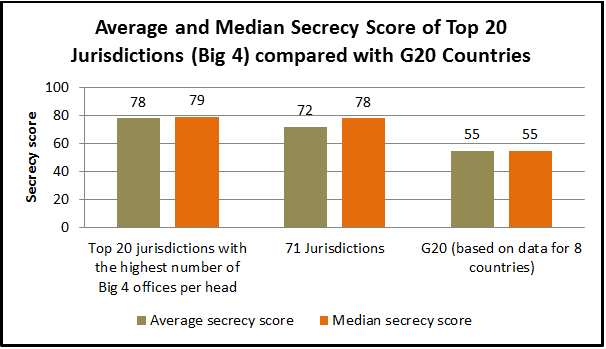
Similarly, we find that comparing the secrecy score of the 20 worst tax havens with the Tax Justice Network's broader list of 71 tax havens and with the G-20 nations shows a much higher mean and median secrecy score in the tax havens than in the non-havens, as the next graph shows.
Source: Tax Research UK
As Richard Murphy, one of the authors of the report, comments at Tax Research UK:
Bonus question for President Obama to pose in the third debate: Why is the "McCain precedent" (2 years of tax returns) more important to you than the George Romney precedent (12 years of returns)?
Of course, this is a silly question on its face. Who do you think designs abusive tax shelters, other than tax accountants and tax attorneys? Now, in a new study by the Tax Justice Network, we see that there is a positive correlation between a jurisdiction's (remember, not all tax havens are independent countries) secrecy index and the number of banks and Big Four accounting firms (PwC, Ernst & Young, KPMG, and Deloitte) per capita present there. The report documents one "leveraged partnership transaction" that PwC both designed and then pronounced to be legally valid (in what is usually termed an "opinion," for which it was paid $800,000), which the U.S. Tax Court strongly criticized as a "conflict of interest" when it upheld the Internal Revenue Service's squashing of this arrangement.
More specifically, we find that the Cayman Islands had the third most Big Four accounting offices per 1000 population at 0.95, compared with just .001 per 1000 for the United States (see Graphs 4 and 5, p. 24, in the report). This density is almost 100 times higher in the Caymans than in the U.S. The Caymans also had more than twice as many banks per 1000 as any other country, at 4.5 per 1000, compared to .023 per 1000 for the U.S. (Graphs 1 and 2). The graph below shows Big Four offices per 1000:
Source: Tax Research UK
Note, too, that Bermuda (which the Romneys also have used) comes in at about .06 per 1000 population, or about 60 times the U.S. rate.
Similarly, we find that comparing the secrecy score of the 20 worst tax havens with the Tax Justice Network's broader list of 71 tax havens and with the G-20 nations shows a much higher mean and median secrecy score in the tax havens than in the non-havens, as the next graph shows.
Source: Tax Research UK
As Richard Murphy, one of the authors of the report, comments at Tax Research UK:
This research lets us conclude that working in conditions of secrecy has become an inherent part of the work of bankers and accountants. It suggests that this has led to a culture of creative non-compliance with laws and regulations, which is likely to increase the potential for, and volume of, crime. At the same time, banks’ and Big 4 firms’ lobbying for laws and regulations that reduce transparency is likely to have resulted in further opacity in the world’s financial system.This, then, is the world in which Mitt Romney travels, a world in which accounting firms actively seek to create tax avoidance opportunities with little concern for whether they step outside the law's boundaries, and in so doing facilitate the transfer of the tax burden from the 1% to the 99%. In my opinion, PwC's assurances about Romney's tax situation are not worth the paper they're printed on.
Bonus question for President Obama to pose in the third debate: Why is the "McCain precedent" (2 years of tax returns) more important to you than the George Romney precedent (12 years of returns)?
Subscribe to:
Posts (Atom)