I'm a little late on this, but I would be remiss if I did not mention the recent death of Terry Coppage, aka BartCop. Bart died March 5th at the age of 60, from complications of the flu, pneumonia, and leukemia.
Bart was one of the pioneers of the liberal blogosphere, starting out in February 1996 with an email newsletter that was converted to web pages by Marc Perkel. He gave much support to new bloggers, including luminaries like Digby and Atrios. Though I never knew him, I am in his debt as well. The affiliated site, Marty Pflugrath's BartCop Entertainment, was the first to permanently and prominently link to me.
In his final column, Bart requested financial help for his wife to help pay for his medical bills. You can send a PayPal payment to bartcop@bartcop.com. If you still use checks, you could send a contribution to bartcop.com, PO Box 54466, Tulsa, OK 74155.
Showing posts with label history. Show all posts
Showing posts with label history. Show all posts
Saturday, March 15, 2014


Sunday, February 19, 2012
Basics: Length of Unemployment is Worst Since World War II.
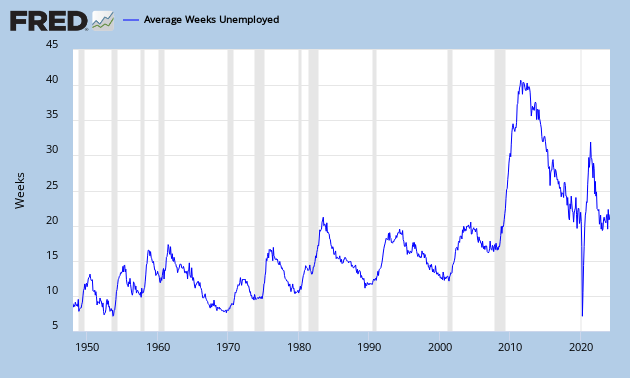
Update: As has been pointed out to me several times, "historically unprecedented" is not correct. I assume that duration of unemployment was longer during the Great Depression. The FRED data below obviously only goes back to 1947. So while "completely unprecedented historically" is literally not correct, duration of unemployment is still off the charts for the postwar era, at just under twice the previous peak.
One thing I've learned since I started blogging is how much people want to see information that puts our current economic situation in perspective. One way to do that, a natural one to me since my specialty is international relations, is to use multi-country comparisons to see where the U.S. stands. Usually this means comparisons with other industrialized countries, although my post on employment protection had data for Brazil, Russia, India, and China as well because the Organization for Economic Cooperation and Development provided it. Moreover, it was striking that the United States would have even worse standards than some developing countries.
Besides that kind of "cross-sectional" comparison of multiple countries at a single point in time, another way to gain perspective is through "longitudinal" comparison of data on one issue through time. Today's post takes that approach. I decided to learn how to use the St. Louis Federal Reserve Bank data you often see in other blogs--although it turns out "learn" is too strong a word because the "FRED" website (https://research.stlouisfed.org/fred2/) is so simple to use. That set me up for a shock to find out how bad long-term unemployment (usually defined as 26 weeks or more) is today. This is a critical issue because the longer you are out of work, the less likely you are to ever find a job again. Unemployment is also critical for health care, as most Americans still get their health insurance through their employers.
As everyone knows, long-term unemployment has been a big problem in the current crisis. But "knowing" isn't the same as having perspective. For that, we need a comparison. It turns out that the average duration of unemployment over the last few months is almost exactly twice as high as the previous peak in 1983 in the aftermath of the Reagan recession. The current average of over 40 weeks is completely unprecedented historically (as is the median length of unemployment, which was also twice that of prior peaks at about 22 weeks when Politifact reported on it in May 2011). But you have to see it to really understand it: Unemployment duration has increased steadily even since the end of the official recession, and may finally have topped out at 40.9 weeks in November 2011. Let's hope we're finally seeing a reduction.
One thing I've learned since I started blogging is how much people want to see information that puts our current economic situation in perspective. One way to do that, a natural one to me since my specialty is international relations, is to use multi-country comparisons to see where the U.S. stands. Usually this means comparisons with other industrialized countries, although my post on employment protection had data for Brazil, Russia, India, and China as well because the Organization for Economic Cooperation and Development provided it. Moreover, it was striking that the United States would have even worse standards than some developing countries.
Besides that kind of "cross-sectional" comparison of multiple countries at a single point in time, another way to gain perspective is through "longitudinal" comparison of data on one issue through time. Today's post takes that approach. I decided to learn how to use the St. Louis Federal Reserve Bank data you often see in other blogs--although it turns out "learn" is too strong a word because the "FRED" website (https://research.stlouisfed.org/fred2/) is so simple to use. That set me up for a shock to find out how bad long-term unemployment (usually defined as 26 weeks or more) is today. This is a critical issue because the longer you are out of work, the less likely you are to ever find a job again. Unemployment is also critical for health care, as most Americans still get their health insurance through their employers.
As everyone knows, long-term unemployment has been a big problem in the current crisis. But "knowing" isn't the same as having perspective. For that, we need a comparison. It turns out that the average duration of unemployment over the last few months is almost exactly twice as high as the previous peak in 1983 in the aftermath of the Reagan recession. The current average of over 40 weeks is completely unprecedented historically (as is the median length of unemployment, which was also twice that of prior peaks at about 22 weeks when Politifact reported on it in May 2011). But you have to see it to really understand it: Unemployment duration has increased steadily even since the end of the official recession, and may finally have topped out at 40.9 weeks in November 2011. Let's hope we're finally seeing a reduction.

Wednesday, January 25, 2012
Jon Stewart Delivers the Goods on Mitt Romney's Taxes
Mitt Romney claims to simply have been following the law in how he paid his taxes for 2010 and 2011. As we have seen, he was able to use the carried interest loophole (taxing hedge fund managers' fees as if they were profits and therefore subject to the 15% capital gains rate rather than being ordinary income) to reduce his tax rate below 14%. But how is that loophole still in existence, despite a bipartisan effort to kill it in 2007?
Building on a recent New York Times story*, Jon Stewart spilled the beans on Romney tonight. On "The Daily Show" (via Mediate, h/t @Phostir), Stewart poses and answers that question. Starting at 3:27 into the clip, Stewart notes Romney's claim to be simply following the tax laws as written. He hows a 2007 video of co-sponsor Sen. Charles Grassley (R-Iowa) talking about how heavily lobbied it was. At 4:51, Stewart answers the question of who was fighting repeal: The Private Equity Council, started in 2007 by, among other firms, Bain Capital. He then plays a clip of Romney himself telling a TV reporter he "doesn't think it's a good idea to raise taxes" in response to a question about this bill.
What Stewart has laid bare for all to see, of course, is exactly how much influence Romney had on the laws that today he claims simply to be following. I'm shocked, shocked... Occupy Wall Street proven right once again.
* "As Romney Campaign Advances, Private Equity Becomes Part of the Debate," NYT, Jan. 11, 2012, p. A17, via Lexis-Nexis Academic.
Building on a recent New York Times story*, Jon Stewart spilled the beans on Romney tonight. On "The Daily Show" (via Mediate, h/t @Phostir), Stewart poses and answers that question. Starting at 3:27 into the clip, Stewart notes Romney's claim to be simply following the tax laws as written. He hows a 2007 video of co-sponsor Sen. Charles Grassley (R-Iowa) talking about how heavily lobbied it was. At 4:51, Stewart answers the question of who was fighting repeal: The Private Equity Council, started in 2007 by, among other firms, Bain Capital. He then plays a clip of Romney himself telling a TV reporter he "doesn't think it's a good idea to raise taxes" in response to a question about this bill.
What Stewart has laid bare for all to see, of course, is exactly how much influence Romney had on the laws that today he claims simply to be following. I'm shocked, shocked... Occupy Wall Street proven right once again.
* "As Romney Campaign Advances, Private Equity Becomes Part of the Debate," NYT, Jan. 11, 2012, p. A17, via Lexis-Nexis Academic.
Saturday, December 17, 2011
Democrats' Continued Caves Threaten Middle Class
Via Mark Thoma, David Graham points out that Senate Democrats are caving in on an issue that looked won a week ago, the millionaire's tax.
So what did Democrats get from the apparent deal to avert a government shutdown? A measly two months' extension of unemployment benefits and the payroll tax cut with the extraneous inclusion of language to force a decision within 60 days on the Keystone XL pipeline. No millionaire's tax. And it's not like tax cuts are the most effective form of economic stimulus anyway -- and this one takes money from Social Security.
Let's get a little historical perspective here. Political scientist Sven Steinmo, in his book Taxation and Democracy (1996), wrote that polls had long showed that Americans thought a major problem with the tax system was that the wealthy didn't pay enough tax. Yet the political system then, and in the 15 years since, has been delivering "tax reform" that has done exactly the opposite, reducing taxes on the rich. One has to question exactly how democratic a political system is that cannot deliver a reform favored by a large majority for at least 30 years.
So, here we stood on the verge of getting at least a little movement in the direction favored by a big majority, and Senate Democrats pull the rug out from under us again. As the Occupy movement has pointed out, something is very rotten in the state of American democracy.
As I wrote earlier, we face lots of hostage-taking opportunities in the future, especially if we are getting shutdown-averting deals that only last two months. If the Democrats keep caving in at this rate, they could give away most of the welfare state by election day.
[Democrats] were calling for a tax cut, after all, and they had Republicans tying themselves in knots explaining why the party of Reagan and Tea didn't want lower taxes. All the Democrats wanted in exchange for extending the reduction was a small increase in how much the wealthy paid -- a position that was widely popular among voters.And then Senate Democrats caved, without a peep from the President, despite his "big speech" in Kansas last week on economic inequality.
So what did Democrats get from the apparent deal to avert a government shutdown? A measly two months' extension of unemployment benefits and the payroll tax cut with the extraneous inclusion of language to force a decision within 60 days on the Keystone XL pipeline. No millionaire's tax. And it's not like tax cuts are the most effective form of economic stimulus anyway -- and this one takes money from Social Security.
Let's get a little historical perspective here. Political scientist Sven Steinmo, in his book Taxation and Democracy (1996), wrote that polls had long showed that Americans thought a major problem with the tax system was that the wealthy didn't pay enough tax. Yet the political system then, and in the 15 years since, has been delivering "tax reform" that has done exactly the opposite, reducing taxes on the rich. One has to question exactly how democratic a political system is that cannot deliver a reform favored by a large majority for at least 30 years.
So, here we stood on the verge of getting at least a little movement in the direction favored by a big majority, and Senate Democrats pull the rug out from under us again. As the Occupy movement has pointed out, something is very rotten in the state of American democracy.
As I wrote earlier, we face lots of hostage-taking opportunities in the future, especially if we are getting shutdown-averting deals that only last two months. If the Democrats keep caving in at this rate, they could give away most of the welfare state by election day.
Sunday, October 16, 2011
Occupy Wall Street points in the right direction
The Occupy Wall Street movement has gotten plenty of press and I've sometimes wondered what I can add to the conversation. But I've decided that it is worth echoing that they are pointing in the right direction regarding how we got into the economic mess we're in. To hear many conservatives tell it, the 2008 financial crisis was caused by the Community Reinvestment Act (CRA), Fannie Mae, Freddie Mac, and ACORN. There is a huge analytical problem with this narrative, though: the financial crisis was a change in outcome, and these supposed wrongdoers had all been around for decades. If the cause doesn't change, it can't be the cause of a changed outcome. We have to look somewhere else for what changed.
The CRA was passed in 1977. Fannie Mae was founded in 1938. Freddie Mac was founded in 1970. The ACORN Housing Corporation, now known as Affordable Housing Centers of America, was founded in 1986. Their existence cannot be what caused a financial crisis 22 years after the last of them (and 70 years after the first of them) was founded. Something had to change.
What changed, of course, was bank regulation and securitization. Laws keeping banks from taking on excessive risk, like the Glass-Steagall Act, were targeted by financial firms and eventually repealed. During the housing boom, private loan originators chopped up mortgages into mortgage-backed securities (MBS), and these mortgages had much greater delinquency and default rates than the ones Fannie and Freddie issued. (F&F did buy some of these securities, but they were not the main player even in that role.) As David Min shows (h/t Paul Krugman), even the riskiest of F&F loans had "serious delinquency" rates in the 2nd quarter of 2010 of under 10.5%, whereas subprime mortgages had a serious delinquency rate over 28%. Private actors got the rules changed in their favor, and dramatically increased their risk-taking to earn huge personal incomes, and the taxpayer bailed them out when it all went bust.
This brings us back to Occupy Wall Street. In the group's "Declaration of the Occupation of New York City," we see that OWS identifies the problem as corporations running government and subverting democracy. As Robert Creamer points out, for OWS politicians are only the problem insofar as corporations (especially on Wall Street) control them. The repeal of bank regulation came about through a decades-long campaign based on political contributions and influence by Wall Street firms. This process is what the Occupy Wall Street manifesto highlights. Occupy Wall Street puts the spotlight on private sector power and greed and demands a change. OWS's manifesto also points out the efforts of corporations to take away employee rights and to use outsourcing to reduce pay and benefits. In a future post, I will discuss the decline of real income in much more detail. It has led to a greater need for two-income families, and then an increase in family debt, in order to maintain a standard of living that was possible on one middle-class income in the 1970s.
I'll close for now with some words from one of my favorite books, Charles Lindblom's Politics and Markets (1977). They could easily have been in the Occupy Wall Street manifesto: "The large corporation fits oddly into democratic theory and vision. Indeed, it does not fit."
The CRA was passed in 1977. Fannie Mae was founded in 1938. Freddie Mac was founded in 1970. The ACORN Housing Corporation, now known as Affordable Housing Centers of America, was founded in 1986. Their existence cannot be what caused a financial crisis 22 years after the last of them (and 70 years after the first of them) was founded. Something had to change.
What changed, of course, was bank regulation and securitization. Laws keeping banks from taking on excessive risk, like the Glass-Steagall Act, were targeted by financial firms and eventually repealed. During the housing boom, private loan originators chopped up mortgages into mortgage-backed securities (MBS), and these mortgages had much greater delinquency and default rates than the ones Fannie and Freddie issued. (F&F did buy some of these securities, but they were not the main player even in that role.) As David Min shows (h/t Paul Krugman), even the riskiest of F&F loans had "serious delinquency" rates in the 2nd quarter of 2010 of under 10.5%, whereas subprime mortgages had a serious delinquency rate over 28%. Private actors got the rules changed in their favor, and dramatically increased their risk-taking to earn huge personal incomes, and the taxpayer bailed them out when it all went bust.
This brings us back to Occupy Wall Street. In the group's "Declaration of the Occupation of New York City," we see that OWS identifies the problem as corporations running government and subverting democracy. As Robert Creamer points out, for OWS politicians are only the problem insofar as corporations (especially on Wall Street) control them. The repeal of bank regulation came about through a decades-long campaign based on political contributions and influence by Wall Street firms. This process is what the Occupy Wall Street manifesto highlights. Occupy Wall Street puts the spotlight on private sector power and greed and demands a change. OWS's manifesto also points out the efforts of corporations to take away employee rights and to use outsourcing to reduce pay and benefits. In a future post, I will discuss the decline of real income in much more detail. It has led to a greater need for two-income families, and then an increase in family debt, in order to maintain a standard of living that was possible on one middle-class income in the 1970s.
I'll close for now with some words from one of my favorite books, Charles Lindblom's Politics and Markets (1977). They could easily have been in the Occupy Wall Street manifesto: "The large corporation fits oddly into democratic theory and vision. Indeed, it does not fit."
Wednesday, September 21, 2011
Historical Notes on Class Warfare
"This is not class warfare. It's math," President Obama said on Monday. There is an important element of truth to this but, as Paul Krugman points out, there has been an "actual class war that has taken place over the past 30 years — namely class warfare for the rich against the middle class." He points to four major elements to this: tax cuts for the rich; a decline in the inflation-adjusted minimum wage (which peaked in 1968 at $10.04 in 2010 dollars); union-busting; and the deregulation of financial markets.
In fact, the war on the middle class goes back even further than that, before President Reagan's crushing of the air traffic controllers' strike, even before he came into office. Douglas Fraser, President of the United Auto Workers, identified a "one-sided class war" in 1978, when he resigned from the "Labor-Management Group" that unofficially advised President Carter. I want to quote at length from this letter, because many of the issues he pointed to then are still with us today.
This is, of course, a good description of the state of labor relations today. At the time, one major example Fraser had in mind was J.P. Stevens, a textile maker and serial National Labor Relations Act violator. The movie "Norma Rae," for which Sallie Field won "Best Actress" in 1979, depicts the struggle against Stevens.
Examples of the latter today are too numerous to mention them all. But we obviously have the Koch brothers financing conservatives all over the country, with restrictions on the right to vote proposed or passed in states like South Carolina, North Carolina, Maine, Wisconsin, and others. Class war from the right is alive and well, but now it challenges science and math as well as labor and the middle class.
In fact, the war on the middle class goes back even further than that, before President Reagan's crushing of the air traffic controllers' strike, even before he came into office. Douglas Fraser, President of the United Auto Workers, identified a "one-sided class war" in 1978, when he resigned from the "Labor-Management Group" that unofficially advised President Carter. I want to quote at length from this letter, because many of the issues he pointed to then are still with us today.
I believe leaders of the business community, with few exceptions, have chosen to wage a one-sided class war today in this country—a war against working people, the unemployed, the poor, the minorities, the very young and the very old, and even many in the middle class of our society. The leaders of industry, commerce and finance in the United States have broken and discarded the fragile, unwritten compact previously existing during a past period of growth and progress....
The latest breakdown in our relationship is also perhaps the most serious. The fight waged by the business community against that Labor Law Reform bill stands as the most vicious, unfair attack upon the labor movement in more than 30 years. Corporate leaders knew it was not the "power grab by Big Labor" that they portrayed it to be. Instead, it became an extremely moderate, fair piece of legislation that only corporate outlaws would have had need to fear. Labor law reform itself would not have organized a single worker. Rather, it would have begun to limit the ability of certain rogue employers to keep workers from choosing democratically to be represented by unions through employer delay and outright violation of existing labor law....
This is, of course, a good description of the state of labor relations today. At the time, one major example Fraser had in mind was J.P. Stevens, a textile maker and serial National Labor Relations Act violator. The movie "Norma Rae," for which Sallie Field won "Best Actress" in 1979, depicts the struggle against Stevens.
We are presently locked in battle with corporate interests on the Humphrey-Hawkins full employment bill. We were at odds on improvements in the minimum wage, on Social Security financing, and virtually every other piece of legislation presented to the Congress recently....Even the very foundations of America's democratic process are threatened by the new approach of the business elite. No democratic country in the world has lower rates of voter participation than the U.S., except Botswana. Moreover, our voting participation is class-skewed—about 50 percent more of the affluent vote than workers and 90 percent to 300 percent more of the rich vote than the poor, the black, the young and the Hispanic. Yet business groups regularly finance politicians, referenda and legislative battles to continue barriers to citizen participation in elections. In Ohio, for example, many corporations in the Fortune 500 furnished the money to repeal fair and democratic voter registration.
Examples of the latter today are too numerous to mention them all. But we obviously have the Koch brothers financing conservatives all over the country, with restrictions on the right to vote proposed or passed in states like South Carolina, North Carolina, Maine, Wisconsin, and others. Class war from the right is alive and well, but now it challenges science and math as well as labor and the middle class.
Subscribe to:
Comments (Atom)